
Wellington after Waterloo
Thomas Creevey, The Creevey Papers (1903)
It has been a damned nice thing, the nearest run thing you ever saw in your life.
SourceRecorded by Thomas Creevey, 19 June 1815. The Creevey Papers, 1903 edition. Public domain.
1769 · 1852 · The Iron Duke
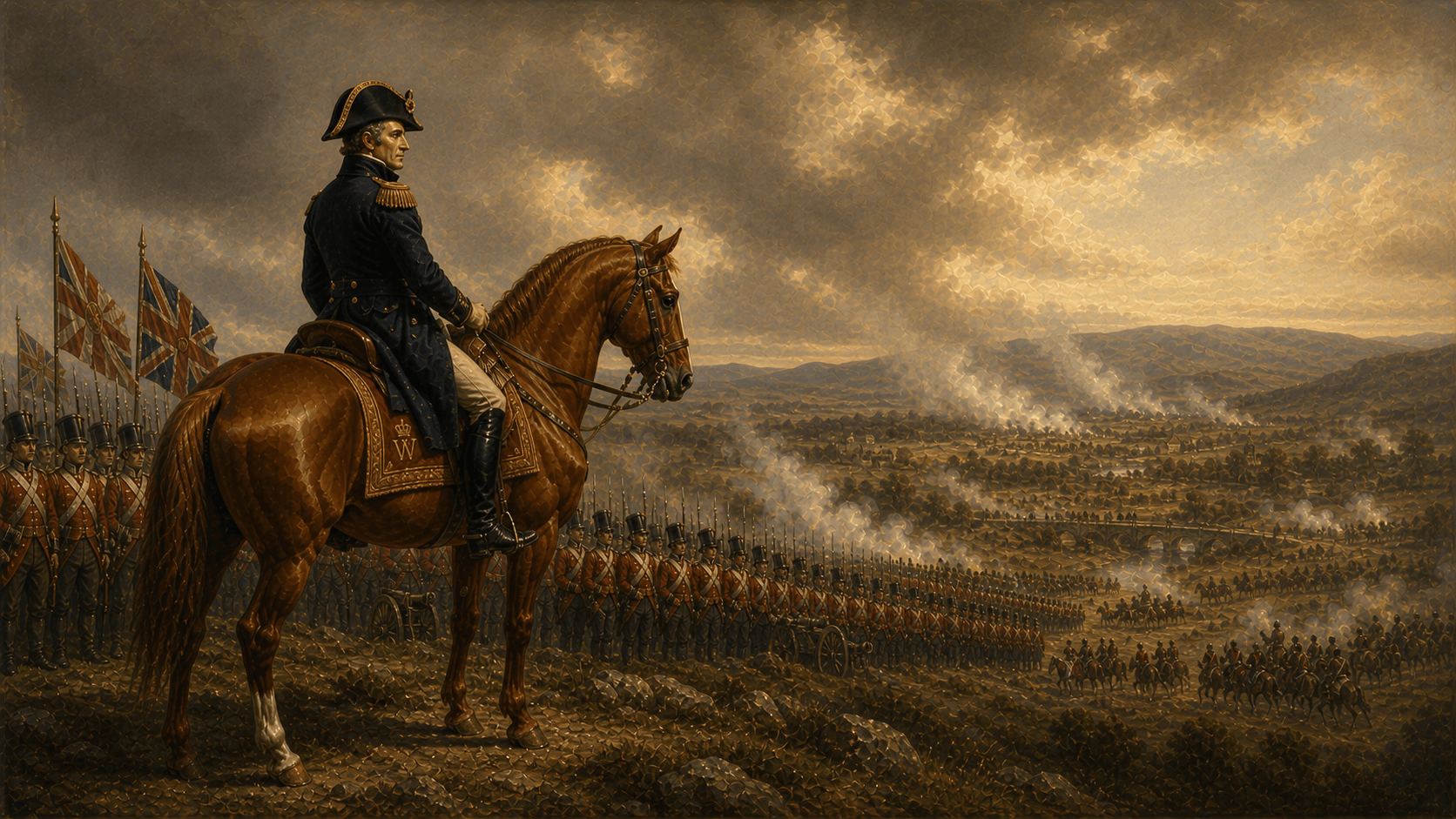
Arthur Wesley (he changed the spelling to Wellesley in 1798) was born in Dublin on 1 May 1769, the same year as Napoleon Bonaparte. He was the third surviving son of the 1st Earl of Mornington, an Anglo-Irish peer of modest means. He was educated at Eton, where by his own later account he was unhappy and undistinguished, and then at the Royal Academy of Equitation at Angers in France, where he learned to ride and to speak French fluently.
He purchased a commission in the army in 1787 and spent the next several years as an aide-de-camp to the Lord Lieutenant of Ireland, with little apparent ambition. He served briefly and unhappily in the disastrous Flanders campaign of 1793-95, an experience that taught him, he later said, what not to do. His career transformed when his elder brother Richard was appointed Governor-General of India in 1797. Arthur followed him east and found his vocation.
In India, Wellesley commanded his first independent campaigns and developed the methods that would define his career: meticulous logistics, careful reconnaissance, respect for local conditions, and an insistence on keeping his men fed, supplied and disciplined. He fought at the siege of Seringapatam in 1799, where the Tippoo Sultan was killed, and was made governor of Mysore afterwards.
His masterpiece in India was the Battle of Assaye on 23 September 1803, where he attacked a Mahratta army that outnumbered him roughly five to one. The fighting was ferocious and the casualties heavy; Wellesley later described Assaye as the bloodiest battle he had ever seen, a verdict he maintained even after Waterloo. He followed it with victories at Argaum and the storm of the fortress of Gawilghur, completing the destruction of the Mahratta Confederacy.
This is the setting for the first three Sharpe novels: Tiger (Seringapatam), Triumph (Assaye) and Fortress (Gawilghur). Cornwell places the fictional Richard Sharpe at Wellesley’s side and has him save the general’s life at Assaye, earning the commission that drives the rest of the series.
Seringapatam, Assaye, Argaum, Gawilghur. Wellesley learned his trade in India: logistics, reconnaissance, attack when outnumbered, and the meticulous attention to supply that would sustain his later campaigns.
Wellesley commanded a division in the British expedition that bombarded Copenhagen and seized the Danish fleet. A secondary operation, but it returned him to European warfare after two years in England.
Wellesley's first Peninsular engagement. British musketry in line shredded advancing French columns on the ridge. The victory was squandered by his superiors, who signed the Convention of Cintra and allowed the French to sail home with their plunder.
Sir John Moore commanded the retreat to Corunna and was killed in the rearguard action. Wellesley was not present. Moore's death cleared the way for Wellesley's return to Portugal as independent commander.
A bloody two-day contest in furnace heat. Wellesley held the line despite heavy casualties and was created Viscount Wellington of Talavera, the title by which he is known for the rest of the war.
Wellington repulsed Masséna's advance on Lisbon at the ridge of Busaco, then withdrew behind the impregnable Lines of Torres Vedras, starving the French out of Portugal without a fight.
Wellington destroyed Marmont's army in forty minutes. By Peninsular tradition, he flung down a chicken bone and said 'By God, that will do!' before riding off to launch the attack. The anecdote is widely repeated; its exact provenance is disputed.
The battle that drove Joseph Bonaparte from Spain. The French army disintegrated among its own baggage train. Wellington was made a Field Marshal and the war moved into France.
The last major battle of the Peninsular War, fought four days after Napoleon's abdication. The news had not reached the armies. Soult withdrew; couriers confirmed the war was over.
Nine hours on the ridge of Mont-Saint-Jean. Wellington held the line until Blücher's Prussians struck Napoleon's flank. The Imperial Guard was broken. The war, and Napoleon's career, ended in a single evening.
Wellington was the anti-Napoleon. Where Napoleon sought the decisive battle and the annihilation of enemy armies, Wellington sought to avoid defeat: to hold ground, conserve his forces, and wait for the right moment to strike. His genius lay in logistics, defensive positioning, and a cold-eyed understanding of what his army could and could not do.
His signature tactic was the reverse slope. He deployed his infantry behind the crest of a ridge, sheltered from enemy artillery, and revealed them only when the French columns crested the rise and received devastating volleys at close range. He used this method at Busaco, Salamanca and Waterloo. He reconnoitred his positions personally, often riding ahead of his own pickets, and had an extraordinary eye for ground.
He fed his army when other generals let theirs starve. His supply system in the Peninsula, based on sea-borne logistics through Lisbon and a chain of fortified depots, kept his men provisioned while the French lived by plunder and went hungry. He insisted on discipline and punished looting severely, not from sentiment but because an army that plundered alienated the local population and destroyed its own supply base.
His view of his own men was famously unsentimental. In a private conversation recorded by the Earl Stanhope in November 1813, he described his soldiers as “the very scum of the earth” who had enlisted for drink, but added that “it really is wonderful that we should have made them the fine fellows they are.” The remark is sometimes quoted out of context as contempt; in full, it is closer to astonished professional pride.
Wellington commanded in the Peninsula for six years, from his landing in Portugal in 1808 to his crossing of the Pyrenees into France in 1814. He fought with a polyglot army of British, Portuguese and Spanish troops, held together by his personal authority, his logistical system, and his refusal to risk a battle he might lose.
His masterwork of 1810-11 was the Lines of Torres Vedras: a chain of 152 forts north of Lisbon, built in secret, behind which he withdrew after Busaco, leaving Masséna’s army to starve in a scorched countryside. The French retreated without a battle. Wellington then struck at the border fortresses of Ciudad Rodrigo and Badajoz in the terrible winter storms of 1812, opening the road into Spain.
The great victories followed: Salamanca in 1812, where he destroyed Marmont’s army, and Vitoria in 1813, which drove the French from Spain for good. By 1814 he was fighting in France itself, winning the last battle of the war at Toulouse.
This is the central theatre of Bernard Cornwell’s Sharpe novels. Sharpe serves under Wellington from Talavera to Toulouse, and Cornwell portrays the general as cold, brilliant, and willing to use Sharpe as an instrument while never quite acknowledging him as an equal.
On 18 June 1815 Wellington fought his greatest and most desperate battle on the ridge of Mont-Saint-Jean. He chose the ground himself, having reconnoitred it the previous year. His army held a two-mile front against nine hours of French assault: the diversionary attack on Hougoumont, the massed infantry columns of d’Erlon, Ney’s unsupported cavalry charges, the fall of La Haye Sainte at dusk.
The crisis came at 19:30 when the Imperial Guard advanced up the ridge. Wellington’s Guards brigade, lying behind the crest, rose to deliver a volley at thirty yards; the 52nd Light Infantry struck the Guard in the flank. The French broke. Wellington waved his hat forward and ordered a general advance. The Prussians, arriving under Blücher, completed the rout.
To Thomas Creevey the next morning, Wellington described the battle as “the nearest run thing you ever saw in your life.” He never fought again.
Wellington entered politics and served as Prime Minister from 1828 to 1830. He passed Catholic Emancipation in 1829, a pragmatic concession he saw as necessary to prevent civil war in Ireland, despite his own Tory instincts. He opposed parliamentary reform and became deeply unpopular: mobs smashed the windows of Apsley House, his London residence, and he earned the nickname the “Iron Duke” not for his generalship but for the iron shutters he fitted to protect the glass.
He served as Commander-in-Chief of the army until his death at Walmer Castle on 14 September 1852, aged eighty-three. He was given a state funeral at St Paul’s Cathedral. Over a million people lined the route.
Wellington is generally regarded as the greatest British soldier since Marlborough. He fought approximately thirty-six battles in his career and never lost one in independent command. His influence on the British army persisted for decades: its regimental system, its emphasis on musketry, and its tradition of defensive stubbornness all owe something to the Peninsular experience.
He remains a complex figure: a brilliant field commander and a reactionary politician, a man who fed his soldiers but despised reform, who freed Catholic Ireland but opposed the extension of the franchise. Apsley House is now a museum; Stratfield Saye remains in the family. The Wellington boot, named for the style he popularised, is perhaps his most democratic memorial.
Fiction · Bernard Cornwell
Wellington appears throughout the Sharpe novels, from a young Colonel Wellesley in India to the victorious commander at Waterloo. Cornwell portrays him as cold, calculating, brilliant and utterly unsentimental. He uses Sharpe as an instrument, recognises his value, and occasionally saves his career, but never quite acknowledges him as a social equal. The relationship is one of mutual respect without warmth. The famous chicken-bone scene at Salamanca, where Wellington flings down his lunch and rides off to launch the attack, is Cornwell at his most vivid.
Genuine verbatim extracts from published public-domain sources
It has been a damned nice thing, the nearest run thing you ever saw in your life.
SourceRecorded by Thomas Creevey, 19 June 1815. The Creevey Papers, 1903 edition. Public domain.
Our friends are the very scum of the earth. Some of our men enlist from having got bastard children, some for minor offences, many more for drink; but you can hardly conceive such a set brought together, and it really is wonderful that we should have made them the fine fellows they are.
SourceNotes of Conversations with the Duke of Wellington by Earl Stanhope, 1888. Conversation of 4 November 1813. Public domain.
I had never yet heard of a battle in which everybody was killed; but this seemed likely to be an exception, as all were going by turns.
SourceAdventures in the Rifle Brigade by Captain John Kincaid, 1830. Public domain.
The definitive single-volume biography. Hibbert covers the soldier, the politician and the private man with equal depth.
Buy on Amazon →Cornwell’s non-fiction account of the Waterloo campaign, drawing on letters and dispatches. Essential companion to Sharpe’s Waterloo.
Buy on Amazon →As an Amazon Associate I earn from qualifying purchases.