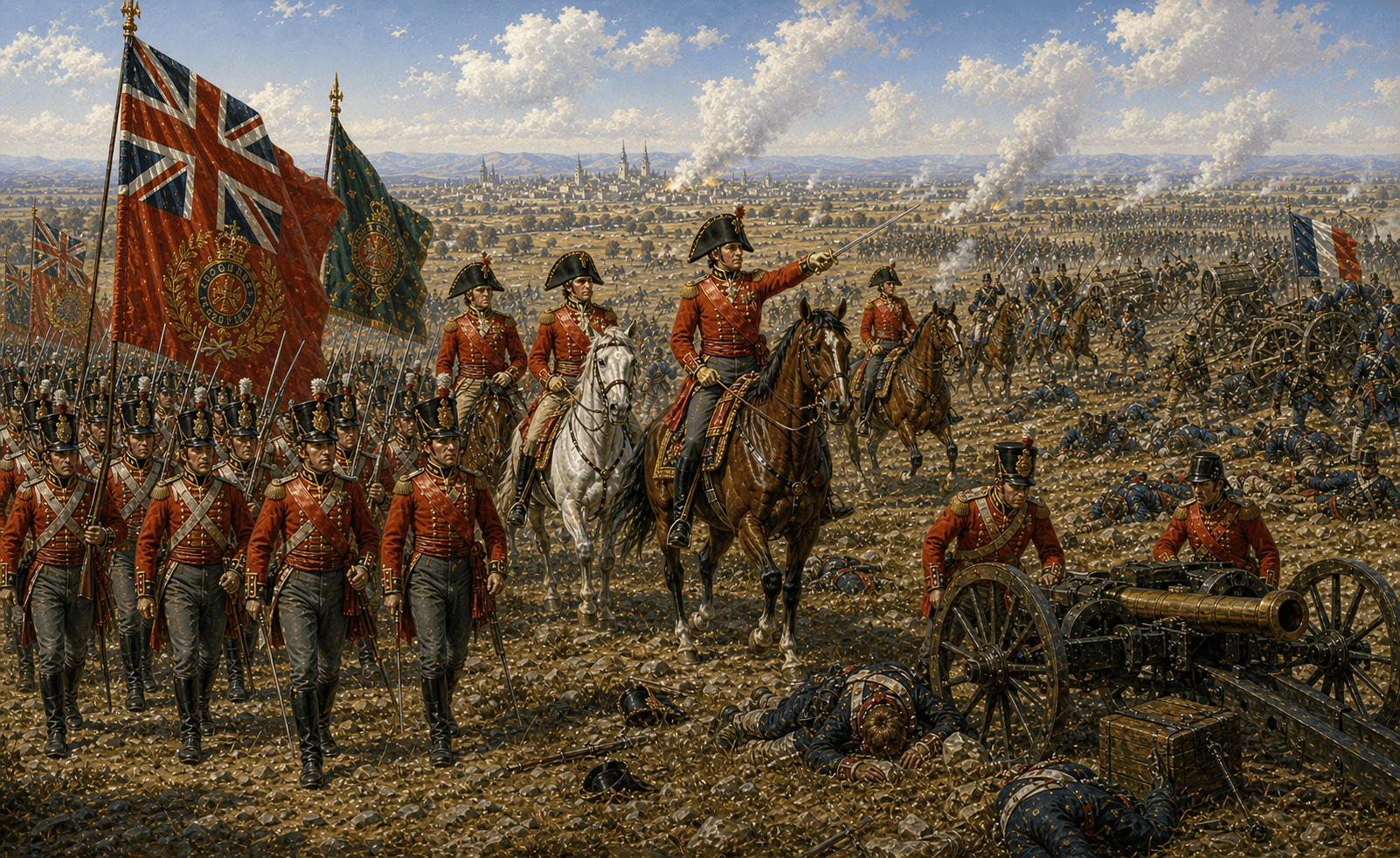
Field Marshal · Commander-in-Chief, Peninsula & Waterloo
Born in the same year as Napoleon. Cold, private, calculating; he spoke of his men as 'the scum of the earth, enlisted for drink.' Yet he shared their biscuit in the mountains and never lost a battle in independent command. At Waterloo he said: 'I should like to be off my horse.'
One-eyed, one-armed, and absolutely without fear. His signal at Trafalgar, 'England expects that every man will do his duty', has never been forgotten. Shot from the mizzen-top of the Redoutable, he died between decks, whispering: 'Thank God, I have done my duty.'
Architect of British light infantry training at Shorncliffe, father of the Light Division. He led the retreat to Corunna through a Galician winter and died on the ridge above the port, urged by his aide: 'I hope, sir, you are not much hurt.' 'I fear I am mortal.'
Martinet, bible-reader, cold terror of the Light Division. He marched the Light Brigade forty-two miles in twenty-six hours to Talavera. Mortally wounded leading the stormers up the lesser breach at Ciudad Rodrigo, he lived four days and is buried in the ditch he took.
Welsh, profane, unbreakable. He fought the Peninsular War in a top hat and greatcoat, swore in chapel and brigade. Shot through the head at Waterloo while leading Kempt's brigade in a counter-charge at the crisis of the day. Buried in civilian clothes; his uniforms were at the cleaner.
A Dorset shepherd turned rifleman. His dictated 'Recollections' give us the private soldier's war: the lice, the hunger, the blistered feet, the dark comedy of the ranks on the retreat to Corunna. He died a shoemaker in London.
The real historical figure, the future Duke of Wellington, commanding the 33rd Foot in India in 1799. In Sharpe's Tiger he is one of Harris's subordinate commanders at Seringapatam and the officer who sanctions the mission Sharpe volunteers for. Cornwell depicts him as cold, precise and professional, already the commander he would become in Spain.
FateSurvives the siege. Goes on to become Major-General in Sharpe's Triumph and eventually Field Marshal and Duke of Wellington, appearing throughout the Peninsular and Waterloo novels.
Historical figure. Commands a separate British column during the Second Anglo-Maratha War. Cooperates with Wellesley during the Assaye and Gawilghur campaigns.
Historical figure. Commands the British force at the Battle of Barrosa 1811. Wins a significant victory despite lack of Spanish cooperation. Sharpe fights under his command in Sharpe's Fury.
Historical figure. One of the most daring naval officers in history. Commands the Chilean independence forces in Sharpe's Devil. Flamboyant, brilliant, and unconventional.
Historical figure. Commander of the 3rd Division throughout the Peninsular War. A ferocious, unconventional general known for fighting in his nightcap. Appears in several Peninsular novels.
FateKilled at Waterloo leading his division against D'Erlon's corps. One of the most senior British officers to die in the battle.
Historical figure. Commands alongside Wellesley at Seringapatam 1799. A hard-nosed, experienced commander who had previously been a prisoner of Tippu Sultan.
FateSurvives Seringapatam. Loses an arm at Corunna 1809.
Historical figure. Wellington's second in command at Waterloo. Commands the Allied cavalry. Has a famous exchange with Wellington after losing his leg to a cannon ball near the end of the battle.
Historical figure. Known as Daddy Hill by his troops for his concern for their welfare, a rare quality among generals of the period. Commands the 2nd Division throughout the Peninsular War. One of Wellington's most trusted subordinates.
FateSurvives the Napoleonic Wars. Later becomes Commander-in-Chief of the British Army.
Historical figure. The future King George IV. Appears in Sharpe's Regiment when Sharpe presents the 2nd Battalion South Essex to him at Hyde Park. Promotes Sharpe to Major.
Historical figure. Commander of the Light Division throughout the Peninsular War. Known as Black Bob for his ferocious discipline. One of the finest light infantry commanders of the era, trained at Shorncliffe like the 95th. Worshipped and feared by his men in equal measure.
FateMortally wounded at the storming of Ciudad Rodrigo January 1812. Dies of his wounds.
Historical figure. Appointed by Wellington to rebuild and command the Portuguese Army. Transforms it into an effective fighting force. Commands at the bloody Battle of Albuera 1811.
British officer at Seringapatam. Historical figure. Major General Rollo Gillespie later became famous for his own Indian campaigns but appears as a junior officer in the Seringapatam action.
FateSurvives Seringapatam. Later killed at Kalunga 1814.
Historical figure. Wellington's chief engineer in the Peninsula. Responsible for designing and constructing the Lines of Torres Vedras. One of the most important officers in Wellington's army.
Historical figure. Wellington's military secretary throughout the Peninsular War and at Waterloo. Has his arm amputated after Waterloo. Later becomes Field Marshal Lord Raglan and commands in the Crimean War.
Seventy-two at Waterloo, hair like a badger's brush, riding at the head of a cavalry charge. Thrown from his horse at Ligny, he lay under the dead until darkness and rose to march to Wellington's aid. 'Ich werde kommen,' he wrote, and came.
One-eyed, corpulent, patient. He gave ground at Borodino, and gave Napoleon Moscow, and then strangled the Grande Armée on the road to Smolensk with famine, Cossacks and cold. He died on the march to Germany, having outlived his usefulness to the Tsar.
The man who commanded all the armies at Leipzig, the first time in history. Cautious, conciliatory, Austrian; he made the coalition hold together where strong personalities would have smashed it apart. Without him, no Battle of the Nations.
The first general to beat Napoleon in a major battle, at Aspern-Essling in May 1809. An epileptic, a reformer, an honest student of war. Dismissed after Wagram; he spent the rest of his life writing treatises that are still read at staff colleges.
A farm-hand from the Salamanca plain whose parents and sister were murdered by French soldiers. He raised a lancer regiment of partisans, served under Wellington, and rode into Salamanca at the head of his Charros in 1812. Wellington loved him; Madrid, afterwards, did not.
Performed for the French garrison in Moscow and survived the retreat. Her memoirs record the burning city, the frozen Berezina, and the terrible kindness of a Russian woman who hid her under straw. The war as civilians saw it.
The real historical ruler of Mysore, known as the Tiger of Mysore. In Sharpe's Tiger he is the target of the British siege: a sophisticated, dangerous opponent who modernised his army with French advisers and iron-cased rockets. Cornwell portrays him closely to the historical record, including his well-attested practice of feeding prisoners to caged tigers.
FateKilled fighting at the northern gate of Seringapatam on 4 May 1799, as in history. His death ended the Kingdom of Mysore as an independent power.
Historical figure. Commands the Dutch-Belgian forces at Waterloo. Known as Slender Billy. His reckless and incompetent orders cost many lives during the battle. A persistent problem for Wellington.
Historical figure. Commander of the Prussian Army at Waterloo. His arrival in the late afternoon saves Wellington's position. Sharpe has a brief interaction with him in Sharpe's Waterloo.
Historical figure. Commander of the South American independence forces alongside Cochrane. One of the liberators of South America. Mentioned in Sharpe's Devil as part of the wider independence struggle.
FateSurvives. One of the great figures of South American history.
A Corsican artilleryman who became master of Europe. His genius lay in movement: in bringing more men to the decisive point than the enemy thought possible. He ruled by Civil Code, by the loot of a continent, and by the devotion of his Old Guard. He died in exile on St Helena, attended by his diary and a handful of grumblers.
A cooper's son from Saarlouis. He commanded the rearguard of the retreat from Moscow. At Waterloo he had five horses shot under him. Tried by the Bourbons after the Hundred Days, he gave the firing squad the order himself.
Bespectacled, austere, undefeated. At Auerstedt his 26,000 men broke a Prussian army nearly twice their size. Alone among the marshals he never lost a battle in independent command. Napoleon trusted him with Hamburg when the Empire was crumbling; he held it to the last.
An innkeeper's son who became Napoleon's brother-in-law and the most theatrical cavalryman in Europe. He rode in plumes, velvet and gold lace; the Russians called his uniforms 'the peacock's feathers.' Shot by a Bourbon firing squad in Pizzo, he gave the order himself, refusing a blindfold.
Gascon, hot-tempered, beloved. The only marshal who addressed Napoleon with the familiar 'tu.' Both his legs were shattered by a cannonball at Aspern-Essling; he died nine days later in Napoleon's arms. The Emperor is said to have wept, perhaps the only time for a subordinate.
Commanded a battalion of the Old Guard in the last square at Waterloo. Legend says that, summoned to surrender, he answered: 'La Garde meurt et ne se rend pas!', or, in the soldier's version, a single untranslatable word. He was taken alive, bloody and bitter.
Historical figure. Commander of the French Army of Portugal during the Torres Vedras campaign. Sharpe operates against his forces during Sharpe's Escape and Sharpe's Fury. Wellington's most formidable opponent in the Peninsula.
FateRecalled to France after failing to break the Lines of Torres Vedras.
Historical figure. One of Napoleon's most capable marshals. Commands French forces in Portugal and Spain during much of the Peninsular War. A persistent opponent of Wellington throughout the campaign.
Historical figure. Known as the Bravest of the Brave. Commands French forces at key moments in the Peninsular War and at Waterloo where he leads the great cavalry charges against Wellington's squares.
FateSurvives Waterloo. Executed by firing squad in Paris December 1815 for treason.
Historical figure. Commands a battalion of the Old Guard at Waterloo. Famous for his response when called upon to surrender, either the single word Merde or the longer defiant speech. His exact words remain disputed by historians.
Historical figure. French divisional commander in Portugal during the Peninsular War. Known for brutal reprisals against the Portuguese civilian population. One of Massena's subordinates during the Torres Vedras campaign.
Historical figure. Commands the French forces that invade Portugal in 1807. Defeated at the Battle of Vimeiro 1808 by Wellesley. His army is repatriated to France under the Convention of Cintra in controversial circumstances.
FateRecalled from Portugal. Later goes mad and dies in 1813.
Historical figure. Commands French forces at the Battle of Barrosa 1811 where General Graham defeats him. Sharpe fights in this battle in Sharpe's Fury.
Historical figure. French divisional commander in the Peninsular War. Wounded at Salamanca. One of the more capable French commanders Sharpe encounters.
Historical figure. Takes command of the French Army of Portugal after Marmont is wounded at Salamanca. Conducts a skilled fighting retreat that saves the army from complete destruction.
Historical figure. Commands the French I Corps at Waterloo. His attack on the Allied centre at 1pm is repulsed by Picton's division and the cavalry charge of the Scots Greys. A pivotal moment in the battle.
Born in a Cat Lane brothel; enlisted to escape a hanging. From sergeant at Assaye to lieutenant-colonel at Waterloo, he is the ladder-climbing rogue at the Empire's edge. Carries a Baker rifle, a heavy cavalry sword he prefers to the regulation sabre, and a permanent chip on his shoulder.
From Donegal, seven-barrelled volley gun at his shoulder, a crucifix under his jacket. Sharpe's friend, conscience, and armourer. The second most dangerous man in any room Sharpe enters, and often the first.
Map-maker, spy-master, patron. A fictional cousin to the real Colquhoun Grant and George Scovell. He sees in Sharpe what the gentlemen officers will not: a useful, lethal, unpolished instrument.
'I cannot be killed, it says so in the Scriptures!' The most loathsome of villains, a survivor of a botched hanging at fourteen. Based loosely on real army bullies; Cornwell's darkest invention. Sharpe kills him at last, by musket, in a ditch.
Lieutenant, 33rd Regiment of Foot (later Colonel, South Essex)
English
First appearance:Sharpe's Tiger
Accompanies Sharpe on the mission into Seringapatam, posing as a fellow deserter. An officer of Sharpe's own regiment and a decent man who comes to respect Sharpe's resourcefulness during their captivity inside Tippu's fortress. Rises through the ranks to Colonel of the South Essex. Wounded at Ciudad Rodrigo, losing an arm, and retires from active command.
FateWounded at Ciudad Rodrigo, loses an arm. Retires from active command of the South Essex. Survives the war.
A Scottish Presbyterian officer of the East India Company serving as an intelligence officer. McCandless is Sharpe's first patron: honourable, devout, and a man whose incorruptibility is the moral counterweight to Hakeswill's venom. In Sharpe's Tiger he is a prisoner of Tippu Sultan whom Sharpe and Lawford must contact inside Seringapatam.
FateSurvives Seringapatam. Returns as Sharpe's protector in Sharpe's Triumph and Sharpe's Fortress. Killed in action in Sharpe's Fortress.
Anglo-Indian (of mixed English and Indian parentage)
First appearance:Sharpe's Tiger
Described as a 22-year-old half-caste widow of Sergeant Bickerstaff. Sharpe's lover during his service in India. Sharpe asks permission to marry her but she eventually leaves him for another man. When Hakeswill threatens her, Sharpe's determination to protect her becomes one of the engines of the novel's plot.
FateLeaves Sharpe at the end of the novel to make a life in India rather than follow him onward. Does not appear in later books.
The indolent, drunken and venal captain of Sharpe's company, and Hakeswill's protector. Morris allows Hakeswill to run the company as he pleases in exchange for a share of the sergeant's corruption. An antagonist throughout Sharpe's time in the 33rd.
FateSurvives Sharpe's Tiger. Reappears later in the India sequence.
Renegade British officer who has defected to the Maratha Confederacy. Primary villain of Sharpe's Triumph. Commands Maratha infantry against the British at Assaye.
Spanish officer and passionate patriot. Sharpe's ally during the Corunna campaign. Devout Catholic. Leads a mission to restore Spanish morale with a holy relic.
FateSurvives Corunna. Returns in Sharpe's Devil as a senior Spanish official.
Red-haired, ever cheerful, clever and well-read. A former schoolmaster from Lichfield. One of Sharpe's two educated chosen men alongside Isaiah Tongue. Loves philosophy and reading. His name is a tribute to the real Benjamin Harris memoirist but he is a different character.
FateKilled at Waterloo trying to save Hagman from a French infantryman. Bayoneted from behind. Sharpe came near tears when he heard.
British aristocrat travelling on the same ship as Sharpe during the voyage to Trafalgar. Antagonist. Suspicious of Sharpe's relationship with his wife.
British intelligence officer operating in Portugal. Primary villain of Sharpe's Havoc. Appears to be working for both sides. Manipulative and treacherous.
Commanding officer of the South Essex Regiment. Cowardly, incompetent, and vindictive. Loses the regimental colour at Valdelacasa in Sharpe's Eagle. The most persistent antagonist among British officers throughout the series. Returns repeatedly to cause trouble for Sharpe.
FateSurvives the war. Disgraced but never truly defeated.
American-born officer in the South Essex from a Boston Loyalist family. Describes himself as an American with a French name from a Royalist family fighting for the English for a German king. Silent, watchful, invariably has a cigar in his mouth.
FateKilled at the Battle of Vitoria leading his men on foot into the village of Gamarra Mayor. Shot in the head. Dies in his first battle as Battalion Commander.
Spanish guerrilla leader in the Torres Vedras campaign. Primary villain of Sharpe's Gold. Initially presented as an ally but revealed to be brutal and self-serving. Rival for Teresa Moreno's affections.
Spanish guerrilla fighter. Fierce, independent, and courageous. Becomes Sharpe's first wife and the mother of his daughter Antonia. One of the most important characters in the series.
FateKilled by Hakeswill in Sharpe's Enemy. He fires his musket blindly as she rides after him and the bullet catches her in the throat. She dies instantly. Sharpe and Teresa had married the day after Badajoz.
Sharpe's daughter with Teresa Moreno. Appears as a young child. After Teresa's death Antonia remains in Spain. Her ultimate fate is not clearly described in the main series.
FateUncertain. Her ultimate fate is not clearly resolved in the main series.
Portuguese criminal mastermind operating in Coimbra. Primary villain of Sharpe's Escape. Controls the black market and has connections to the French. Brutal and cunning.
Young officer first seen in Sharpe's Company. From Hampshire, youngest son of a shipwright. An inveterate gambler and seducer of women. Sharpe likes him despite himself. One of the most reliable junior officers in the later novels.
FateSurvives the war. Appears in Sharpe's Waterloo.
French guerrilla hunter. Primary villain of Sharpe's Battle. Commands a grey-uniformed regiment specialising in counter-guerrilla warfare. Brutal and effective. One of Sharpe's most dangerous opponents.
Incompetent and cowardly British officer assigned to command the Real Compania Irlandesa. Comic villain of Sharpe's Battle. More interested in comfort than soldiering.
French intelligence officer and master swordsman. Primary villain of Sharpe's Sword. Has been unmasked Wellington's intelligence network. Dangerous, cunning, and a formidable fighter.
Spanish woman who becomes Patrick Harper's wife. First appears attached to the South Essex during the Peninsular campaign. Devoted to Harper throughout the later novels.
French officer who cooperates with Sharpe against the deserters in Sharpe's Enemy. Honourable and professional, one of Cornwell's rare sympathetic French officers. Sharpe respects him.
French intelligence officer. One of the series' most persistent villains. Calculating, ruthless, and highly intelligent. Operates behind the scenes manipulating events against Sharpe and Wellington across multiple novels.
Commanding officer of the 2nd Battalion South Essex in England. Primary villain of Sharpe's Regiment. Running a crimping racket, using the battalion to press men into service while pocketing their pay. Brutal disciplinarian.
FateDriven mad by his first taste of real battle at the Battle of the Nivelle. Sharpe takes command.
Secretary for War. Uses his mistress Lady Anne Comoynes to seduce Sharpe and find out what he knows. Sends assassins to kill Sharpe. Forced to capitulate when Lady Anne produces the incriminating ledgers.
Sharpe's second wife. Met during the investigation into the South Essex crimping racket in England. Young, beautiful, and initially devoted to Sharpe. Later leaves him for Lord Rossendale while Sharpe is on campaign.
FateLeaves Sharpe. Becomes Lord Rossendale's mistress. Does not appear after Sharpe's Waterloo.
Royal Navy captain. Villain of Sharpe's Siege. Arrogant and incompetent. Commands the naval element of the Atlantic coast raid and constantly undermines Sharpe.
Officer in the 60th Rifles. Known as Sweet William. Missing an eye, several teeth, and part of an ear, hence the ironic nickname. One of Sharpe's most capable allies in the later Peninsular novels and in France.
FateSurvives the wars. Appears in Sharpe's Revenge.
French widow living on a farm in Normandy. Sharpe's enduring companion after the Napoleonic Wars. Intelligent, calm, and deeply good. Represents the peace Sharpe never expected to find. Mother of Sharpe's son Patrick.
FateSurvives. Still with Sharpe in Normandy at the end of Sharpe's Devil.
British cavalry officer. Becomes Jane Sharpe's lover while Sharpe is on campaign in France. Represents the wealthy, privileged world that Sharpe can never fully enter.
French officer. Brother of Lucille Castineau. Initially suspicious of Sharpe's relationship with his sister. A man of honour who comes to respect Sharpe.
Fenner's mistress, forced to prostitute herself to pay off her late husband's debts. Initially used by Fenner to seduce Sharpe, she ultimately betrays Fenner by producing the incriminating ledgers that expose the crimping racket.
FateFreed from Fenner's control when Sharpe forces Fenner to cancel her debts.
Welsh rifleman in the 95th Rifles. One of Sharpe's chosen men. Could have made Sergeant but Sharpe felt he lacked ruthlessness. Never disobeyed orders. Good friends with Tongue and Harvey. Loves fishing.
FateLast mentioned in Sharpe's Sword. Does not appear in later novels.
Young Spanish woman rescued by Ben Perkins during Sharpe's Battle after being raped by French soldiers under Brigadier Loup. Becomes attached to Perkins.
FateMurdered by French agents in Sharpe's Honour. Buried in the same grave as Perkins pays his respects.
Portuguese camp follower and former lover of Sharpe's. A beautiful and worldly woman. She and Sharpe have a complicated history. She reappears in Sharpe's Enemy where Sharpe nearly succumbs to her again before Teresa arrives.
Scottish general officer who becomes one of Sharpe's most important patrons in the later Peninsular novels. Clever, sardonic, and supportive of Sharpe. Takes over some of Hogan's intelligence role after Hogan's death.
Irish Catholic priest based in Salamanca. Acts as a British intelligence agent. A loyal friend to Sharpe and an unlikely spy. Appears in the Salamanca campaign novels.
Incompetent and arrogant officer posted to Sharpe's Light Company in Sharpe's Escape. Undermines Sharpe's authority and puts men's lives at risk through his incompetence. A source of considerable tension.
Irish nobleman commanding the Real Compania Irlandesa in Sharpe's Battle. A tragic figure, proud, alcoholic, and ultimately broken by the impossible position he finds himself in.
FateDies during the campaign, suicide or killed in battle.
Commanding officer of the South Essex who replaces Lawford in Sharpe's Company. Brings Hakeswill back into the regiment. Killed by Leroux during his escape in Sharpe's Sword.
Member of Sharpe's chosen men. Goes missing in action after the Battle of Bussaco in Sharpe's Escape, last seen escaping from the French after being surrounded. His fate is never resolved.
FateMissing in action after Bussaco. Fate unknown.
Simmerson's nephew and accomplice in Sharpe's Eagle. A bully and coward who backs up Simmerson's incompetent command. Antagonist to Sharpe. Appears only in Sharpe's Eagle and does not recur.
German mercenary who commands the Maratha infantry at Assaye. A former sergeant in the East India Company army who has risen to high command in Maratha service. Intelligent and dangerous.
FateSurvives Assaye. Fate after the battle uncertain.
Second in command of the South Essex. Inexperienced and nervous but basically decent, unlike many of Simmerson's officers. Supports Sharpe where he can. Takes temporary command after Lawford is wounded at Ciudad Rodrigo and again after Windham's death, leading the South Essex at Salamanca. Later transferred to a staff position in Lisbon.
FateTransferred to a staff position in Lisbon before Sharpe's Honour. Survives the war.
Officer of the South Essex Light Company in Sharpe's Eagle. A Scotsman who retired from the army after India but rejoined after losing his wife. Mortally wounded during Simmerson's foolish action at Valdelacasa when the King's Colour is lost. As a dying request, he asks Sharpe to take a French Eagle to erase the shame.
FateMortally wounded at Valdelacasa. Dies of his wounds.
Friend of Colonel Windham who takes the vacant majority in Sharpe's Company ahead of the more deserving Leroy. Small man with a clipped moustache, cropped grey hair and bowed horseman's legs. Often seen at Windham's side.
FateKilled during the assault on the breach at Badajoz.
Rifle officer. Sharpe's original company commander before the retreat to Corunna. Commands the company at Copenhagen and the early Peninsular campaign.
FateSurvives. Appears briefly in Sharpe's Waterloo.
Brother of Don Blas Vivar. The Count of Mouromorto. Primary antagonist of Sharpe's Rifles, has allied himself with the French against his own country for political reasons.
Sister of Colonel Philippe Leroux. A French agent operating inside British lines in Salamanca. Beautiful and dangerous. Sharpe's love interest in Sharpe's Sword. At the end of the novel she gives Sharpe a replacement telescope in a rosewood box, a gift from Napoleon to his brother Joseph, King of Spain.
FateSurvives. Her subsequent fate is not described.
Officer who purchases a captaincy in Sharpe's Company and is given command of Sharpe's light company over Sharpe. Described as good looking and fair haired but fatally indecisive in battle. Harper says his worst crime as a commander is that he cannot make up his mind.
British intelligence officer who works alongside Hogan and later assists Sharpe during the Salamanca campaign in Sharpe's Sword. Investigates the French spy network operating inside British lines.
Member of Sharpe's chosen men. Wounded in action during the French victory at Oporto in Sharpe's Havoc and is unable to walk. Sharpe is forced to leave him behind.
FateMissing in action as of Sharpe's Havoc. Left behind wounded at Oporto. Fate unknown.
One of the riflemen from the retreat to Corunna. A complainer and malingerer, the least popular man in the company. Sharpe tolerates him because he is a good shot.
Portuguese officer and lawyer who joins Sharpe during the Oporto campaign in Sharpe's Havoc. Intelligent, principled, and idealistic. Becomes one of Sharpe's most trusted allies in the early Peninsular novels. Struggles with the violence of war given his civilian background.
FateSurvives. Appears in subsequent Peninsular novels.
Elderly British officer in Sharpe's Enemy. Commands the garrison at Adrados. More interested in his young wife than in soldiering. His incompetence and absence of authority allows the situation with the deserters to deteriorate.
Young wife of Colonel Farthingdale in Sharpe's Enemy. Her capture by the deserters is one of the catalysts for the plot. Much younger than her husband.
Spanish royalist Governor of Chile. Primary villain of Sharpe's Devil. Ruthless, corrupt and politically cunning. Has imprisoned Don Blas Vivar and is using his position for personal enrichment. Sharpe travels to Chile to investigate Vivar's disappearance and finds Bautista behind it.
Spanish naval captain commanding the Espiritu Santo, the ship that takes Sharpe to Chile. Initially an antagonist, arrogant and hostile to Sharpe. Ultimately a man of honour who finds himself on the wrong side of history.
British consul in Valdivia, Chile. Assists Sharpe on his arrival in Chile. A pragmatic man who has to navigate between the Spanish royalists and the Chilean independence forces.
French royalist officer in Sharpe's Assassin. Connected to the La Fraternite assassination plot against the restored Bourbon monarchy. Operates in Paris 1815.
Female French agent operating in Spain. Steals Ben Perkins' green jacket when Sharpe paroled her after capture, it was the only one small enough to fit a woman. Appears in Sharpe's Battle.