Robert Clive
Victor of Plassey and founder of the Company's territorial power in India. He amassed an enormous personal fortune and was investigated by Parliament for corruption. He took his own life in 1774, aged forty-nine.
Founded 1600 · Dissolved 1858 · The company that became an empire
For 258 years, a London trading company governed a subcontinent, fought wars, collected taxes, grew opium, and made and unmade kings. No commercial organisation in history has wielded comparable power.
On 31 December 1600, Queen Elizabeth I granted a Royal Charter to “The Governor and Company of Merchants of London Trading into the East-Indies.” The original subscribers were London merchants seeking to break the Dutch monopoly on the spice trade. The first Governor was Sir Thomas Smythe, a veteran of the Levant Company, and the initial capital was modest by later standards.
The Company’s early years were focused on spices: pepper, nutmeg, cloves and mace from the Indonesian archipelago and the coasts of India. Its headquarters were modest offices in the City of London. It competed fiercely with the Dutch VOC (Vereenigde Oostindische Compagnie) and was initially outmuscled in the Spice Islands, particularly after the Amboyna massacre of 1623, which pushed it away from Indonesia and towards India instead. This near-failure turned out to be the making of the Company.
The Company shifted from trade to territory in stages. It established its first permanent trading posts, known as factories, at Surat in 1613, Madras (Fort St George) in 1639, Bombay in 1668 (received as part of the dowry of Catherine of Braganza), and Calcutta (Fort William) in 1690. For over a century it operated as a commercial enterprise within the framework of the Mughal Empire, paying duties and negotiating privileges.
The Mughal Empire’s decline in the early eighteenth century, accelerated by the Persian invasion of 1739 and the Afghan raids that followed, created a power vacuum across the subcontinent. Regional rulers emerged, fought each other, and sought European military support. The Company, with its disciplined sepoy armies and access to European weapons and tactics, was ideally placed to exploit the chaos.
The turning point was the Battle of Plassey on 23 June 1757. Robert Clive, with roughly 3,000 troops (of whom 2,100 were Indian sepoys), defeated the Nawab of Bengal, Siraj ud-Daulah, whose army numbered perhaps 50,000. The victory was achieved less by fighting than by bribery and conspiracy: Clive had suborned the Nawab’s general, Mir Jafar, who held his forces back. By 1765 the Company had acquired the Diwani of Bengal: the right to collect revenue from one of the richest provinces in Asia. The transformation from merchant to ruler had begun.
The Napoleonic Period · 1790 to 1815
By the 1790s the East India Company had become a state within a state. In London, a Court of 24 Directors elected by shareholders governed the Company’s affairs, while the Board of Control, introduced by Pitt’s India Act of 1784, gave the British government oversight of political and military decisions. In India, the Governor-General in Calcutta was the most powerful British official outside London, commanding three Presidency armies (Bengal, Bombay and Madras) that together fielded over 200,000 men, the vast majority of them Indian sepoys.
Richard Wellesley, Marquess Wellesley, arrived as Governor-General with an aggressive policy of expansion. His instrument was the Subsidiary Alliance system: Indian rulers were compelled to accept Company troops garrisoned in their territories, paid for by the ruler, and commanded by Company officers. Rulers who refused were attacked; those who accepted became dependents. The system gradually absorbed independent Indian states into the Company’s orbit without formal annexation.
Wellesley gave his younger brother Arthur the military commands that would make him. In the Fourth Anglo-Mysore War of 1799, Arthur Wellesley fought at the siege of Seringapatam, where Tippu Sultan was killed and the Kingdom of Mysore was destroyed. In the Second Anglo-Maratha War of 1803-05, Arthur won the battles of Assaye, Argaum and Gawilghur, breaking the Mahratta Confederacy. Richard Wellesley was recalled to London in 1805 amid controversy over the cost and aggression of his policy, but the territorial gains were never reversed.
The backbone of Company power was the sepoy: the Indian soldier recruited, trained and equipped on European lines, commanded by a mix of British and Indian officers. The sepoys were professional, disciplined and generally loyal, but the relationship was always unequal. Company officers (who held commissions from the Company, not the Crown) were paid less and promoted more slowly than King’s officers, breeding resentment on both sides. Pay and conditions for Indian soldiers were adequate but not generous, and the Company’s disregard for caste and religious sensitivities would, in time, contribute to the catastrophe of 1857.
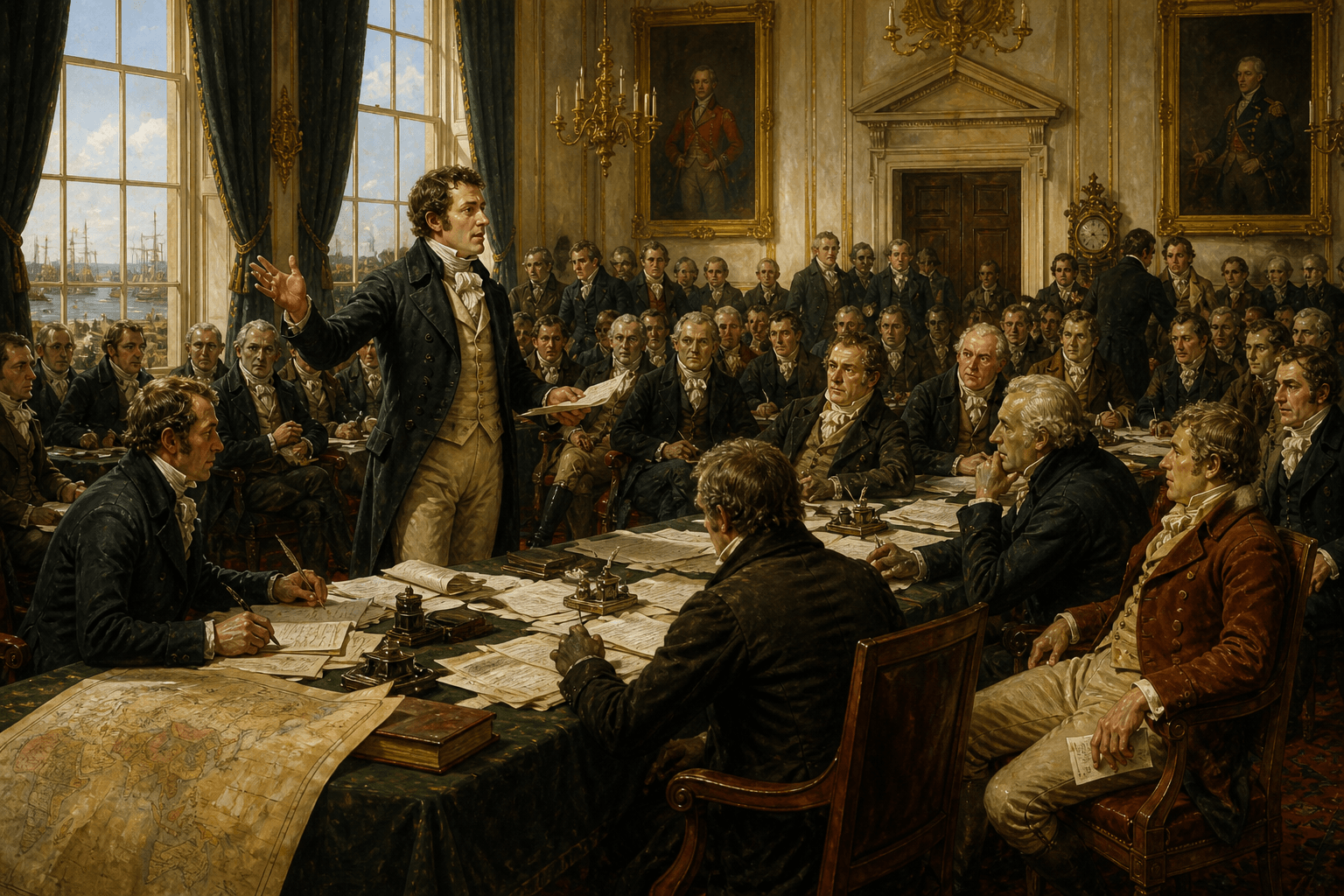
In London, the Company rebuilt East India House on Leadenhall Street in 1799-1800, a grand classical building that housed its administrative headquarters, its museum, and its vast archive. The Company’s political influence was enormous: it employed the relatives of hundreds of MPs and funded political campaigns. Its most profitable trade was opium, cultivated under Company monopoly in Bengal and sold to China through private merchants, generating extraordinary profits that sustained both the Company and the British exchequer. The Charter Act of 1813 ended the Company’s monopoly on Indian trade, opening it to all British merchants, but the Company retained its monopoly on the China trade (and with it the opium revenues) until 1833.

The Company’s record cannot be separated from its human cost. The drain of wealth from India to Britain over two centuries was immense; the economist Utsa Patnaik has estimated it at $45 trillion in modern terms, though the methodology and figure are disputed by other historians. What is not disputed is that Bengal, one of the richest textile-producing regions in the world in 1750, was impoverished within a generation of Company rule. Indian weavers were forced to sell at fixed prices; British manufactured goods were imported duty-free; and the Bengali textile industry was systematically destroyed.
The Bengal famine of 1770, which killed an estimated ten million people (approximately one third of the population), was exacerbated by the Company’s insistence on collecting land revenue even as crops failed. Forced cultivation of indigo and opium displaced food crops. In its early years, the Company also participated in the slave trade, transporting enslaved people between its Asian territories. The historian William Dalrymple has characterised the Company as a corporate state that pioneered the techniques of aggressive colonial expansion.
The historical debate continues. Some historians note that the Company also built roads, railways (in its final decades), codified laws, established universities, and created institutions that outlasted it. Others argue that these achievements were incidental to exploitation, and that the infrastructure served primarily to extract wealth more efficiently. An honest account must acknowledge both the scale of the destruction and the complexity of the legacy.
The Charter Act of 1813 ended the Company’s monopoly on Indian trade. The Charter Act of 1833 ended its China trade monopoly as well, leaving the Company as a purely administrative and military body, governing India on behalf of the Crown but no longer trading. It had become, in effect, a branch of the British state wearing a corporate mask.
Resentment grew among Indian soldiers and rulers alike. Lord Dalhousie’s Doctrine of Lapse (1848-56) annexed Indian states whose rulers died without direct heirs, regardless of adopted successors. The policy was legally dubious and politically incendiary. The final trigger was the introduction of the new Enfield rifle in 1857, whose cartridges were rumoured to be greased with cow and pig fat, offensive to both Hindu and Muslim sepoys who had to bite them open before loading.
In 1857 the accumulated grievances of a century of Company rule exploded into the most serious challenge to British power in India. The story of the uprising and the Company’s dissolution is told on a dedicated page, coming soon.
Victor of Plassey and founder of the Company's territorial power in India. He amassed an enormous personal fortune and was investigated by Parliament for corruption. He took his own life in 1774, aged forty-nine.
Served as Governor-General from 1773 to 1785. A capable administrator who consolidated Company rule, he was impeached by Parliament on charges of corruption and cruelty in a trial that lasted seven years. He was acquitted in 1795.
The aggressive expansionist who doubled the Company's territory through the Subsidiary Alliance system. He gave his brother Arthur the military commands that produced Seringapatam, Assaye and Gawilghur. Recalled over the cost of his wars.
Learned his trade in Company service in India. His victories at Assaye and Gawilghur gave him the reputation and experience he carried into the Peninsular War and Waterloo.
The Company's greatest Indian opponent. He modernised his army with French advisers, used rockets against the British, and resisted Company expansion until his death at the siege of Seringapatam in 1799. Known as the Tiger of Mysore.
Sharpe · Taboo
The first three Sharpe novels are set against the Company’s wars in India. Private Sharpe storms Seringapatam alongside Arthur Wellesley in Tiger, fights the Mahrattas at Assaye in Triumph, and takes the fortress of Gawilghur in Fortress. Cornwell uses the Company as background rather than subject, but the world Sharpe moves through is the Company’s India: sepoys, Company officers, nabobs, and the collision of European and Indian military traditions.
Tom Hardy’s television series is set in 1814 and shows the Company’s London face: the boardroom of East India House, the political corruption, the ruthlessness with which the Company defended its interests. It is fiction, and takes considerable dramatic liberties, but it is rooted in the Company’s real political power and willingness to use violence to protect its monopolies. Worth watching as a companion piece to the historical record.
The definitive modern account of the East India Company’s rise from a small London trading venture to a corporate sovereign ruling a subcontinent. Dalrymple draws on Indian, Persian and Company sources to tell the story from all sides. Essential reading for anyone interested in the Company era.
As an Amazon Associate I earn from qualifying purchases.