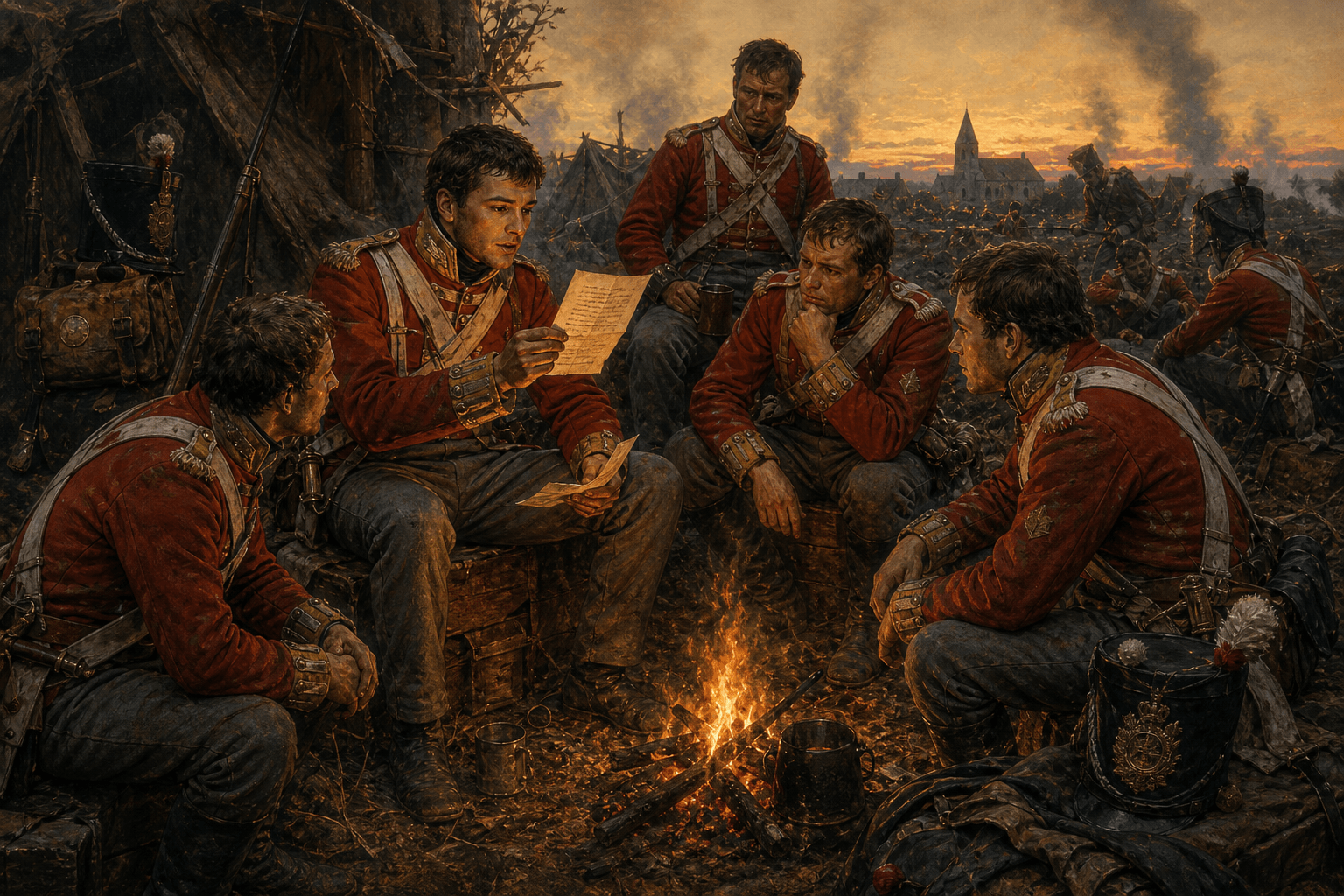
Benjamin Harris, 95th Rifles · Recollections (1848)
The retreat across Galicia, December 1808 to January 1809
My shoes had given out long before. The men tied strips of raw oxhide about their feet, bloody side in, and so we went: the women carrying children, the children carrying loaves, the loaves mouldered black. I saw a wife of the 43rd fall down in the snow and her man would not leave her; a sergeant cut him across the back with a scabbard, and still he sat with her. When we came up the pass again the French dragoons had taken the lot.
NoteHarris's dictated memoirs are the best private-soldier document we have of the Peninsula. His plain voice gives the retreat a reality no dispatch can.
SourceRecollections of Rifleman Harris, 1848. Public domain.
Sir John Kincaid, 95th Rifles · Adventures in the Rifle Brigade (1830)
After the storm, 7 April 1812
For three days and three nights Badajoz was a hell. Our own officers could not go among the soldiery without being shot at; men quarrelled over the plate of a sacristy and killed one another in the streets. I saw a Rifleman lying drunk upon a damasked bed, the curtains pulled down for his blanket, an image of the Virgin at his feet. The priests were weeping in their own church. The General would not have it stopped; he could not.
NoteKincaid's humour and honesty make him the best-loved of the Peninsular memoirists. Wellington's own reports after Badajoz are terse and ashamed.
SourceAdventures in the Rifle Brigade by Sir John Kincaid, 1830. Public domain.
He was brought down at twenty past one. The ball had broken his spine. He lay on a cot in the midshipmen's berth, covered with a sheet; the powder-monkeys had to be kept from staring at him. He asked constantly, 'How goes the day with us?' and when told we had eighteen prizes he said twice, 'God be praised, I have done my duty.' He died at half past four, his hand upon Hardy's.
NoteBeatty's official account remains the primary source. Nelson's body was preserved in a cask of brandy for the voyage home, hence the sailor's name for rum: 'Nelson's blood.'
SourceThe Death of Lord Nelson by Dr William Beatty, 1807. Public domain.
We were four thousand of the Guard left. The cold had glued the muskets to our hands; to let go was to leave the skin behind. When the Russian artillery opened upon us at Krasny we did not even form square, for we could not. We marched in column straight through the fire, and when we came out upon the further side we counted not the dead but the living, and they were less than half.
NoteBourgogne's memoir is the retreat from Moscow as a sergeant lived it: frost-bitten, starved, and still, to the end, faithful.
SourceMémoires du Sergent Bourgogne, 1835. Public domain.
Cavalié Mercer, Royal Horse Artillery · Journal of the Waterloo Campaign (1870)
The ridge at Mont-Saint-Jean, 18 June 1815
Mercer describes how his battery of nine-pounders held its ground on the ridge as wave after wave of French cavalry charged the Allied line. He writes of the cuirassiers riding uphill through the mud, the guns firing at point-blank range into the mass of horsemen, the ground between the guns filling with dead horses and men in steel breastplates. He refused Wellington's order to shelter his gunners inside the infantry squares, judging that if they ran, the raw Dutch-Belgian infantry nearby would break. His battery kept firing.
NoteMercer's journal, published posthumously in 1870, is the finest artillery memoir of the period. His vivid account of the cavalry charges has shaped how the battle is visualised for two centuries.
SourceSource: Journal of the Waterloo Campaign by General Cavalié Mercer, 1870. Public domain. This is a summary of the account in our own words, not a verbatim extract. The original text is available via the sources listed on our Resources page.
Private William Wheeler · The Letters of Private Wheeler, 1809–1828
The Peninsular War, 1809 to 1814
Wheeler's letters home describe the daily reality of the ordinary infantryman in the Peninsula: the long marches under a broiling sun, the short rations, the bivouacs in rain without blankets, and the moments of sudden violence when a French column appeared over a ridge. He writes of the camaraderie of the ranks, the dark humour of soldiers who knew each battle might be their last, and the steady erosion of men by disease, exhaustion and the occasional musket ball.
NoteWheeler's letters were edited and published by B.H. Liddell Hart in 1951. They provide a rare and largely unembellished record of the Peninsula from the perspective of a literate private soldier.
SourceSource: The Letters of Private Wheeler 1809–1828, edited by B.H. Liddell Hart, 1951. This is a summary of the account in our own words, not a verbatim extract. The original text is available via the sources listed on our Resources page.
Sergeant James Anton · Retrospect of a Military Life (1841)
The Peninsular War, the 42nd (Black Watch) at various actions
Anton describes the experience of the Highland regiments in the Peninsula: the pride of the kilt in battle, the bagpipes playing the men into action, and the terrible cost of frontal assaults against prepared positions. He writes of comrades lost at Quatre Bras and Waterloo, of the disciplined advance of the 42nd through fields of rye taller than a man, and of the moment when the Highland charge broke the French line.
NoteAnton's memoir is one of the few published accounts from a Highland NCO of the period. His pride in the regiment and his honest descriptions of the cost of battle make it an essential source for the Black Watch's war.
SourceSource: Retrospect of a Military Life by James Anton, 1841. Public domain. This is a summary of the account in our own words, not a verbatim extract. The original text is available via the sources listed on our Resources page.
Captain Cavalié Mercer, Royal Horse Artillery · Journal of the Waterloo Campaign (1870)
The ridge at Mont-Saint-Jean, approximately 4pm, 18 June 1815
Mercer describes the French cuirassiers advancing uphill towards his battery in successive waves. His guns fire at point-blank range into the mass of horses and steel-clad men. The ground between the guns fills with dead and dying horses, their riders trapped beneath them. He writes of the extraordinary spectacle of armoured cavalry riding through a storm of canister, the front ranks falling while the rear ranks press forward over the bodies. His battery fires until the barrels are too hot to touch.
NoteMercer's journal, published posthumously in 1870, is the finest artillery memoir of the period. His account of the cavalry charges has shaped how the battle is visualised for two centuries.
SourceSource: Journal of the Waterloo Campaign by General Cavalié Mercer, 1870. Public domain. This is a summary of the account in our own words, not a verbatim extract.
The ridge at Mont-Saint-Jean, approximately 7:30pm, 18 June 1815
Gronow describes the final crisis of Waterloo: the advance of the Imperial Guard up the slope in the evening twilight. He writes of the dense blue columns approaching through the smoke, the drums beating the pas de charge, and the extraordinary moment when the Guards were ordered to stand and fire. The French column halted, staggered by the volley at thirty yards, and then the British Guards charged with the bayonet. The Imperial Guard broke and fled. Gronow writes that the cry 'La Garde recule' spread across the French army like a wave.
NoteGronow's Reminiscences are among the most entertaining memoirs of the Regency period. His account of Waterloo, written decades later, captures the surreal calm of a young officer watching the most important moment in European history unfold at thirty yards.
SourceSource: Reminiscences and Recollections of Captain Gronow, 1862. Public domain. This is a summary of the account in our own words, not a verbatim extract.
Lieutenant John Kincaid, 95th Rifles · Adventures in the Rifle Brigade (1830)
Badajoz, morning of 7 April 1812
Kincaid describes walking through the town on the morning after the storming. He writes of British soldiers drunk on plundered wine, lying unconscious in the streets alongside the dead. He saw men quarrelling over silver plate from churches, officers unable to control their own men, and the extraordinary sight of soldiers dressed in looted finery: silk gowns, priests' vestments, women's bonnets. The contrast between the night's horror and the morning's grotesque carnival is Kincaid's particular genius.
NoteKincaid is the wittiest of the Peninsular memoirists. His account of Badajoz balances dark humour with genuine horror at what the army became in those three days.
SourceSource: Adventures in the Rifle Brigade by Sir John Kincaid, 1830. Public domain. This is a summary of the account in our own words, not a verbatim extract.
General Armand de Caulaincourt · With Napoleon in Russia (memoir written 1812-13)
The road from Moscow to Smolensk, November 1812
Caulaincourt, Napoleon's Master of the Horse, describes the retreat in language of controlled despair. He writes of men freezing to death standing upright, of horses that could not keep their footing on the ice, of entire regiments dissolving into stumbling crowds of starving men. He records Napoleon's silence as the army disintegrated around him, and the Emperor's occasional bursts of furious energy when news arrived of yet another disaster. The cold, Caulaincourt writes, was beyond anything the army had experienced or imagined possible.
NoteCaulaincourt's memoir, dictated to his secretary during and immediately after the campaign, is the closest we have to Napoleon's own account of 1812. His proximity to the Emperor gives his account unique authority.
SourceSource: With Napoleon in Russia: The Memoirs of General de Caulaincourt (written 1812-13, published posthumously). Public domain translation available. This is a summary of the account in our own words, not a verbatim extract.
Lieutenant George Simmons, 95th Rifles · A British Rifle Man (1899)
The siege and storming of Badajoz, April 1812
Simmons describes the weeks of preparation in the trenches before Badajoz, the steady attrition from French fire during the siege, and the terrible night of the assault. He writes of advancing into the ditch beneath the breach in total darkness, of the chevaux de frise and the explosions that tore through the storming parties, and of the hours of repeated attempts to force a way through. His account gives the rifleman's experience of the siege: the patience of the investment followed by the sudden violence of the storm.
NoteSimmons's journal, published in 1899 as A British Rifle Man, covers his entire Peninsular service. His Badajoz entries are among the most detailed accounts from a junior officer of the 95th.
SourceSource: A British Rifle Man: The Journals and Correspondence of Major George Simmons, 1899. Public domain. This is a summary of the account in our own words, not a verbatim extract.
Sergeant Thomas Morris, 73rd Regiment · Recollections of Military Service (1845)
The ridge at Mont-Saint-Jean, afternoon of 18 June 1815
Morris describes the experience of standing in an infantry square while French cavalry charged repeatedly. He writes of the ground shaking with the approach of the cuirassiers, the order to hold fire until the horsemen were within yards, and the crash of the volley that emptied saddles at point-blank range. Between charges, men stepped forward to bayonet wounded horses and drag French casualties clear. The square held, but the hours of bombardment between charges killed more men than the charges themselves.
NoteMorris's account is one of the most vivid private-soldier descriptions of what it felt like to stand in a square under cavalry attack. Published in 1845, it captures both the terror and the strange routine of the experience.
SourceSource: Recollections of Military Service by Sergeant Thomas Morris, 73rd Regiment, 1845. Public domain. This is a summary of the account in our own words, not a verbatim extract.
Captain John Kincaid, 95th Rifles · Adventures in the Rifle Brigade (1830)
Vitoria, evening of 21 June 1813
Kincaid describes the extraordinary scene after the French collapse at Vitoria: the entire French baggage train captured intact. He writes of carriages stuffed with silver and gold, of Joseph Bonaparte's personal treasure scattered across the road, of soldiers breaking open strongboxes and filling their shakos with coins. The pursuit of the French halted entirely as the army fell upon the plunder. Officers could not control their men. Wellington, Kincaid notes, was furious at the indiscipline that allowed the French to escape.
NoteKincaid's dry wit makes this one of the most entertaining passages in Peninsular memoir literature. His honest admission that the army preferred looting to fighting captures a reality that official dispatches preferred to omit.
SourceSource: Adventures in the Rifle Brigade by Captain John Kincaid, 1830. Public domain. This is a summary of the account in our own words, not a verbatim extract.
Commissary August Schaumann, King's German Legion · On the Road with Wellington (1924)
The retreat across Galicia, December 1808 to January 1809
Schaumann, a Hanoverian commissary officer attached to the British army, describes the administrative collapse of the retreat. He writes of supply wagons abandoned on frozen roads, of rations that never arrived, of the impossible task of feeding an army in headlong retreat through mountains in winter. His perspective is unusual: not the fighting soldier's view but the supply officer's despair as the system he maintained broke down around him. He describes soldiers too exhausted to eat even when food was available.
NoteSchaumann's journal, published in 1924 from his original papers, gives the Peninsular War from the perspective of a logistics officer. His account of the Corunna retreat complements Harris's private-soldier view with an understanding of why the supply system failed.
SourceSource: On the Road with Wellington by Commissary August Schaumann, 1924 (from original journals). Public domain. This is a summary of the account in our own words, not a verbatim extract.