
The Napoleonic Archive
The NapoleonicArchive
The Napoleonic Archive

The Battle of Waterloo

18 June 1815 · Mont-Saint-Jean, Belgium

Date
18 June 1815
Location
Brabant, Belgium
Duration
~9 hours
Result
Allied victory

The Armies

Anglo-Allied Army

Duke of Wellington
68,000 men
156 guns
Victory

French Army

Emperor Napoleon
72,000 men
246 guns
Defeat

Prussian Army

Field Marshal Blücher
50,000 engaged
104 guns
Victory

Casualties

Anglo-Allied~17,000
French~25,000 killed/wounded + 8,000 captured
Prussian~7,000
~190,000
Total engaged
~49,000
Total casualties

All casualty figures are approximate and vary between historical sources.

The Day, Hour by Hour

  1. 11:30

    The attack on Hougoumont

    Prince Jérôme Bonaparte's division assaulted the walled chateau and farm complex on Wellington's right flank. What Napoleon intended as a diversion drew in ever more French troops throughout the day, while the British and Nassauer defenders held the buildings and the orchard against repeated infantry attacks.

  2. 13:00

    D'Erlon's I Corps attacks the Allied centre

    Four divisions of the Comte d'Erlon's I Corps, approximately 16,000 men, advanced in dense columns against the Allied line east of the Brussels road. They overran La Haye Sainte's garden and reached the crest of the ridge before being thrown back by Picton's division and the charge of the Household and Union cavalry brigades.

  3. 14:30

    Picton killed leading the counter-charge

    Lieutenant-General Sir Thomas Picton, commanding the 5th Division, was shot through the head while leading his brigade forward to meet d'Erlon's columns. He was the most senior Allied officer killed in the battle; he had fought in civilian clothes, his uniform having been lost in transit.

  4. 15:30

    Ney launches the great cavalry charges

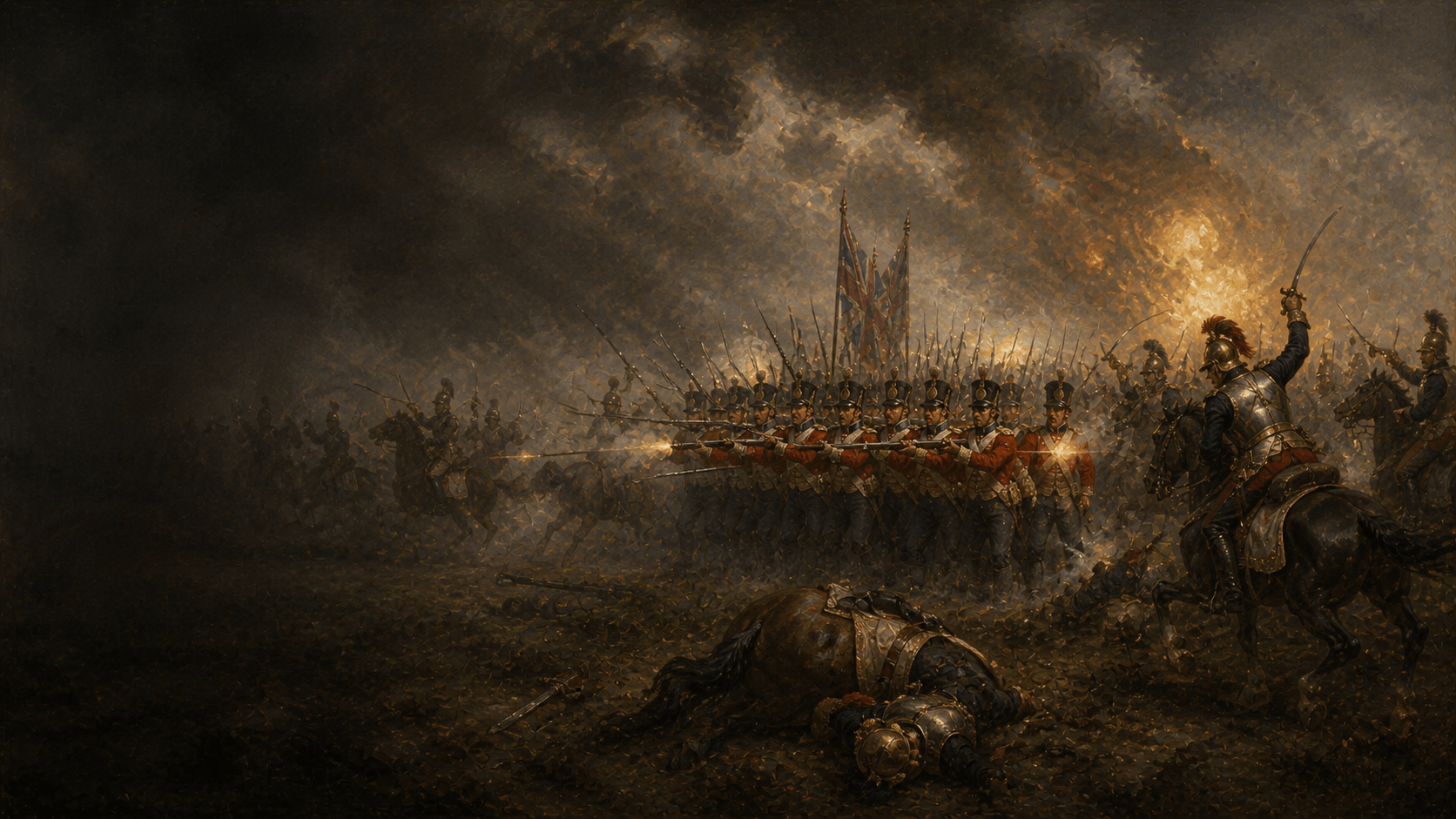
    Marshal Ney, possibly misreading a realignment of Allied units as a withdrawal, launched wave after wave of unsupported heavy cavalry against Wellington's infantry squares on the right-centre of the ridge. Without infantry or horse artillery support the cuirassiers and lancers could not break the squares, and over two hours were repulsed with devastating losses.

  5. 18:00

    La Haye Sainte falls

    The King's German Legion garrison under Major Baring, having exhausted their rifle ammunition, was overwhelmed by French infantry. The fall of this central position opened a gap in Wellington's line and allowed French skirmishers to fire directly into the Allied squares at close range, causing severe casualties.

  6. 19:00

    The Prussians strike Plancenoit

    Blücher's leading corps under Bülow attacked the village of Plancenoit on Napoleon's right rear, threatening the French line of retreat along the Brussels road. Napoleon was forced to divert the Young Guard and eventually two battalions of the Old Guard to hold the village, weakening his reserves at the critical moment.

  7. 19:30

    The Imperial Guard advances

    Napoleon committed his last reserve. Five battalions of the Middle and Old Guard advanced up the slope of Mont-Saint-Jean in echelon towards the Allied line. They were met by devastating musket volleys from Maitland's Guards brigade, who had been lying down behind the crest, and were then struck in the flank by the 52nd Light Infantry under Colonel Colborne.

  8. 20:00

    La Garde recule. The Empire is finished.

    The Imperial Guard broke and retreated, the first time the Old Guard had ever been seen to give ground in battle. The cry 'La Garde recule!' spread through the French army. Wellington, standing in his stirrups, waved his hat forward and ordered a general advance. The French army disintegrated into a rout pursued by Prussian cavalry into the night.

The Key Ground

Hougoumont

The walled chateau, farm and orchard on the Allied right. Defended throughout the day by the Coldstream and Third Guards, Nassauers and Hanoverians, against repeated French infantry and artillery assault. Its defence pinned down a disproportionate number of French troops. Wellington later said that the outcome of the battle turned upon the closing of the gates of Hougoumont.

La Haye Sainte

The farmhouse astride the Brussels road in the centre of Wellington's line. Garrisoned by the 2nd Light Battalion of the King's German Legion armed with Baker rifles, it held out for most of the day until its ammunition was exhausted around 18:00. Its fall was the crisis of the battle, opening a gap through which French skirmishers poured fire into the Allied line.

Papelotte

The hamlet and farm complex on the Allied far left, held by Nassauer troops under Prince Bernhard of Saxe-Weimar. It formed the hinge between Wellington's line and the arriving Prussian forces. Fighting here was fierce but secondary to the main action; its importance lay in anchoring the junction between the two Allied armies.

The Ridge of Mont-Saint-Jean

Wellington's chosen defensive position: a low east-west ridge bisected by the Brussels road. His infantry were deployed on the reverse slope, sheltered from direct French artillery fire. They rose to deliver volleys only when the French crested the ridge, then retired behind the crest again. This use of ground was Wellington's signature tactic from the Peninsula, and it blunted Napoleon's artillery advantage throughout the day.

The Commanders

Commander-in-Chief, Anglo-Allied Army

Directed the battle from the ridge of Mont-Saint-Jean, repeatedly riding forward to the most threatened points under heavy fire. He later described Waterloo as the nearest-run thing you ever saw in your life. He survived the battle unscathed.

Emperor of the French

Commanded the French army from the inn of La Belle Alliance, south of the battlefield. He committed the Imperial Guard too late and with too little support. After the rout he fled to Paris and abdicated four days later; he died in exile on St Helena in 1821.

Marshal of the Empire

Led the great cavalry charges against Wellington's squares and personally directed the Imperial Guard's final advance. He had five horses shot under him during the day. He was tried and executed by the restored Bourbon government in December 1815.

Field Marshal, Prussian Army

Seventy-two years old and only two days recovered from being ridden over at the Battle of Ligny, he marched his army to Wellington's aid and struck Napoleon's right flank at Plancenoit in the late afternoon. His arrival decided the battle.

Lieutenant-General, 5th Division

The most senior Allied officer killed at Waterloo. He was shot through the head while leading Kempt's brigade in a counter-charge against d'Erlon's corps at approximately 14:30. He had fought the day concealing a wound received at Quatre Bras two days earlier.

General, Old Guard

Commanded a battalion of the Old Guard in the final stand. Tradition attributes to him the defiant reply when summoned to surrender; the exact words are disputed by historians. He was wounded and captured on the field.

Regiments at Waterloo

British & Allied

French

Prussian Army

Blücher's IV Corps under Bülow struck Plancenoit on Napoleon's right flank from late afternoon; I and II Corps arrived progressively through the evening, completing the pursuit after the French rout.

Voices from the Battle

Genuine verbatim extracts from published public-domain memoirs

Captain John Kincaid, 95th Rifles

Adventures in the Rifle Brigade (1830)
I had never yet heard of a battle in which everybody was killed; but this seemed likely to be an exception, as all were going by turns.

SourceAdventures in the Rifle Brigade by Captain John Kincaid, 1830. Public domain.

Captain Cavalié Mercer, Royal Horse Artillery

Journal of the Waterloo Campaign (1870)
On they came in compact squadrons, one behind the other, so numerous that those of the rear were still below the brow when the head of the column was but at some sixty or seventy yards from us, and all the while the ground shook beneath their thundering tramp.

SourceJournal of the Waterloo Campaign by General Cavalié Mercer, 1870. Public domain.

Captain Rees Howell Gronow, 1st Foot Guards

Reminiscences and Recollections (1862)
The word of command, “Prepare to receive cavalry,” had been given, every man in the front ranks knelt, and a wall bristling with steel, held together by steady hands, presented itself to the infuriated cuirassiers.

SourceReminiscences and Recollections of Captain Gronow, 1862. Public domain.

Sharpe at Waterloo

Fiction · Bernard Cornwell

Sharpe’s Waterloo (1990)

In the final full novel of the series, Lieutenant-Colonel Richard Sharpe serves as a liaison officer attached to the Prince of Orange’s staff on the Allied ridge. Cornwell follows Sharpe through the defence of Hougoumont, the cavalry charges, and the crisis at La Haye Sainte, ending with the repulse of the Imperial Guard at dusk.

What Cornwell got right

  • The sequence and timing of the battle follow the historical record closely: Hougoumont, d’Erlon, the cavalry charges, La Haye Sainte, the Guard.
  • The terrain, the weather (overnight rain, muddy ground delaying the French attack), and the key tactical decisions are accurately depicted.
  • Real commanders appear in their documented roles: Wellington on the ridge, Ney leading the charges, Picton killed in the counter-attack.
  • The arrival of the Prussians and the final rout match the historical timeline.

Fictional elements Cornwell added

  • Sharpe himself is fictional, as is his role as a liaison officer at the battle.
  • The Prince of Orange is portrayed as recklessly incompetent; while this has some historical basis, Cornwell amplifies it for dramatic effect.
  • Several secondary characters and personal subplots (including Sharpe’s conflicts with officers on the Allied staff) are invented.
  • Sharpe participates directly in the defence of Hougoumont and the repulse of the Guard, placing him at every key moment of the day.

Visit Waterloo Today

Mémorial 1815

The modern visitor centre at the foot of the Lion’s Mound offers an immersive underground exhibition covering all three days of the campaign (Ligny, Quatre Bras and Waterloo) with panoramic film, artefacts and a 3D battle model. It is the starting point for any visit to the battlefield.

waterloo1815.be

Hougoumont Farm

The walled farm complex on the Allied right has been restored and opened as a museum. The north gate, where the fighting was fiercest, is preserved; the chapel and courtyard still show marks of the battle. It is a short walk across the fields from the Mémorial.

The Lion’s Mound

The 40-metre artificial hill topped by a cast-iron lion was raised by the Kingdom of the Netherlands in the 1820s on the approximate spot where the Prince of Orange was wounded. Two hundred and twenty-six steps lead to a panoramic view of the entire battlefield. Wellington is said to have complained that the construction of the mound had altered the landscape he fought over.

Getting There

The battlefield is approximately 20 km south of Brussels. Regular buses run from Brussels-Midi station to Braine-l’Alleud (line W); the journey takes about 40 minutes. By car, follow the N5 south from Brussels towards Charleroi. The Mémorial car park is well signposted from the motorway exit. Allow a full day to visit the visitor centre, the Lion’s Mound, Hougoumont and La Haye Sainte on foot.

Further Reading

Waterloo: The History of Four Days, Three Armies and Three Battles

Bernard Cornwell, 2014

Cornwell’s own non-fiction account of the campaign, drawing on letters, diaries and dispatches to reconstruct the four days from Napoleon’s crossing of the frontier to the rout on the Brussels road.

Buy on Amazon →

The Campaigns of Napoleon

David G. Chandler, 1966

The single-volume standard in English on Napoleon as a soldier. Chandler’s account of the Waterloo campaign runs to over a hundred pages and remains essential reading for any serious student of the battle.

Buy on Amazon →
Browse all resources →

As an Amazon Associate I earn from qualifying purchases.