
Napoleon’s Russian Campaign
1812 · The March That Destroyed an Empire
Why Napoleon Invaded
The root cause of the Russian Campaign lay in the Continental System, Napoleon’s attempt to strangle Britain by closing every European port to British trade. The strategy was economically brutal but demanded absolute enforcement: a single defecting power could unravel the blockade and allow British goods to flood the Continent. By 1810, Tsar Alexander I had grown weary of the economic pain the System inflicted on Russia. Russian nobles were losing fortunes as British markets dried up and the rouble collapsed. In December 1810 Alexander opened Russian ports to neutral shipping, a transparent fiction that restored trade with Britain. To Napoleon it was an act of deliberate hostility.
There were other irritants. Napoleon had annexed the Duchy of Oldenburg in northern Germany, whose duke was Alexander’s uncle, without compensation. Russian ambitions in the Ottoman Empire chafed against French interests. The two emperors who had embraced at Tilsit in 1807 as the masters of Europe were now barely concealing their mutual contempt. Napoleon’s calculation was simple in outline: a short, sharp campaign to inflict a decisive defeat near the border, force a treaty, and compel Russian compliance with the System. He had done it to Austria twice and to Prussia once. He expected to do it again.
The fatal miscalculation was to assume that Russia would behave as a western European state. Russia had almost no major cities the loss of which would be strategically decisive, roads that turned to mud in rain and dust in dry weather, and a ruling class that could sustain military humiliation as long as the army survived. Napoleon’s model of war, built on the swift annihilation of the enemy’s field force followed by a peace conference, had no mechanism for dealing with an adversary willing to burn its own capital and keep retreating.
The Grande Armée
The army that crossed the Niemen river in June 1812 was the largest single military force ever assembled in European history to that point: approximately 685,000 men drawn from every corner of Napoleon’s empire and its client states. Alongside French veterans marched Poles, Prussians, Austrians, Italians, Dutch, Swiss, Westphalians, Bavarians, Saxons, Spaniards and Croatians. It was an army that reflected the extraordinary reach of Napoleonic power at its zenith.
The French core, organised in the numbered corps under marshals of proven ability, retained the qualities that had won Austerlitz and Jena: flexibility, speed of movement, and the esprit that came from years of shared victory. The Imperial Guard, Napoleon’s elite reserve, contained some of the finest soldiers in the world. The cavalry, massed in greater numbers than on any previous campaign, was capable of sweeping reconnaissances and devastating pursuit.
The vulnerabilities were equally significant, and most were visible before a single shot was fired. An army of 685,000 men and its animals consumed enormous quantities of food, fodder, and ammunition every single day. The supply trains assembled for the campaign were the largest in French experience but were still wholly inadequate for the distances involved. Russian roads were primitive and would destroy wheeled transport with brutal efficiency. The army’s composition, drawing on conscripts and allied contingents whose loyalty was conditional, was a weakness that would deepen under stress. And the army had no established base in Russia: every mile east was another mile from France.
The Advance: Niemen to Smolensk
On 24 June 1812 the Grande Armée began crossing the Niemen river near Kaunas. Napoleon stood on the bank watching his columns stream across the pontoon bridges, and reportedly asked a Polish officer whether the river had ever been crossed. The symbolism was deliberate: here was the edge of the old world, and beyond lay conquest. What no one said was that Hannibal had also crossed his Rubicon.
The Russian army, commanded by Barclay de Tolly and subsequently also by Bagration with his separate Second Army, declined to fight. The orders from St Petersburg were ambiguous but the strategic logic was clear enough: the Russian forces were too small individually to confront the Grande Armée and needed to concentrate first. French cavalry repeatedly lunged at the retreating columns only to find that the Russians had slipped away in the night. The pursuit was exhausting and demoralising.
As the French advanced, the scale of the Russian strategy became apparent. Villages were abandoned, crops burned, fodder destroyed, wells poisoned. The army that had lived off the land in Italy, in Germany, and in Poland now found itself crossing a scorched landscape. The supply trains that had set out from Germany were already breaking down on the roads east of the Niemen. Horses were dying from lack of fodder. Men were dying from dysentery, typhus, and the sheer physical attrition of covering fifteen to twenty miles a day in summer heat without adequate food. The campaign was barely two weeks old and the army was already consuming itself.
Smolensk: First Blood
By early August the two Russian armies had finally united near Smolensk. For a brief moment it appeared that Napoleon might achieve his decisive battle. The Russians briefly considered an offensive but hesitated, and Napoleon moved to cut their line of retreat. On 16 and 17 August French forces stormed the outer defences of Smolensk in furious fighting, breaking into the suburbs as the city burned around them.
The engagement was inconclusive in the worst possible sense. The Russians suffered heavily but were not destroyed: Barclay de Tolly conducted a fighting withdrawal under the cover of darkness, preserving the army and leaving Napoleon in possession of a gutted city of no strategic value. The French paid thousands of casualties for a name on the map. The road to Moscow lay open but so did the terrible truth that the Russians simply refused to accept the kind of battle that would end the campaign. Napoleon pushed east.
Borodino: The Bloodiest Day
Barclay de Tolly’s refusal to fight had made him politically untenable in Russia. Under enormous pressure from the Tsar and the nobility, he was replaced in August by Mikhail Kutuzov, the old one-eyed veteran of Austerlitz who was respected by the Russian people if not always by the Tsar. Kutuzov had no intention of fighting an open battle but he understood that he could not abandon Moscow without making some stand. He chose a position near the village of Borodino, on the old post road to Moscow, and ordered his army to entrench.
On 7 September 1812 the two armies fought what remains one of the bloodiest single days in military history. Approximately 250,000 men were engaged and around 70,000 became casualties before nightfall: roughly 35,000 on each side. The French assault, launched against the Russian fortifications, the Great Redoubt and the Bagration flêches on the southern flank, was conducted with extraordinary courage by both sides. The fighting for the Great Redoubt alone cost thousands of lives.
Napoleon’s failure at Borodino was not tactical but strategic. At every crisis in the day his marshals – Ney, Murat, Davout – demanded that he commit the Imperial Guard to deliver the decisive blow. Each time Napoleon refused. He was unwell, uncertain, and unwilling to risk his last reserve so far from France. The Guard stood and watched as lesser regiments broke themselves against Russian cannon. When darkness fell the Russian army was battered but intact, and Kutuzov withdrew it eastward during the night. Napoleon had won the field but not the campaign.
A dedicated Borodino page will be added to this archive in due course. Until then, see the Battles index for related articles.
Moscow: A City on Fire
On 14 September 1812 the Grande Armée entered Moscow. Napoleon rode through streets that were almost entirely empty. The population had fled, the governor had ordered the city’s magazines and warehouses set ablaze, and by nightfall the fires had spread beyond control. Much of the ancient city burned for several days. The army found shelter in what remained but the prize for which they had marched fifteen hundred miles was a shell, stinking of ash, stripped of the food and forage that might have sustained the men through a winter campaign.
Napoleon waited. He sent three separate peace overtures to Alexander; all were ignored or went unanswered. The Tsar, influenced by his advisors and by a genuine patriotic fury at the invasion, refused to negotiate while a French soldier stood on Russian soil. Alexander had the luxury of waiting: every day the army sat in Moscow its horses consumed fodder that could not be replaced, its discipline eroded, and the Russian armies gathering to the south and east grew stronger.
Napoleon waited thirty-five days in Moscow, from 14 September to 19 October. By the time he admitted that no peace was coming and gave the order to march, winter was already approaching. It was almost certainly too late.
The Retreat: Road Without End
Napoleon attempted to return via Kaluga and a different route than the one he had come, hoping to find untouched country. At Maloyaroslavets on 24 October the army fought a furious engagement against Kutuzov’s force for control of the road south. The town changed hands several times and was eventually left a smoking ruin. Kutuzov did not pursue aggressively but positioned his army to block the southern route, and Napoleon, unwilling to risk another engagement with depleted forces, turned onto the Smolensk road: the same road they had already destroyed on the advance.
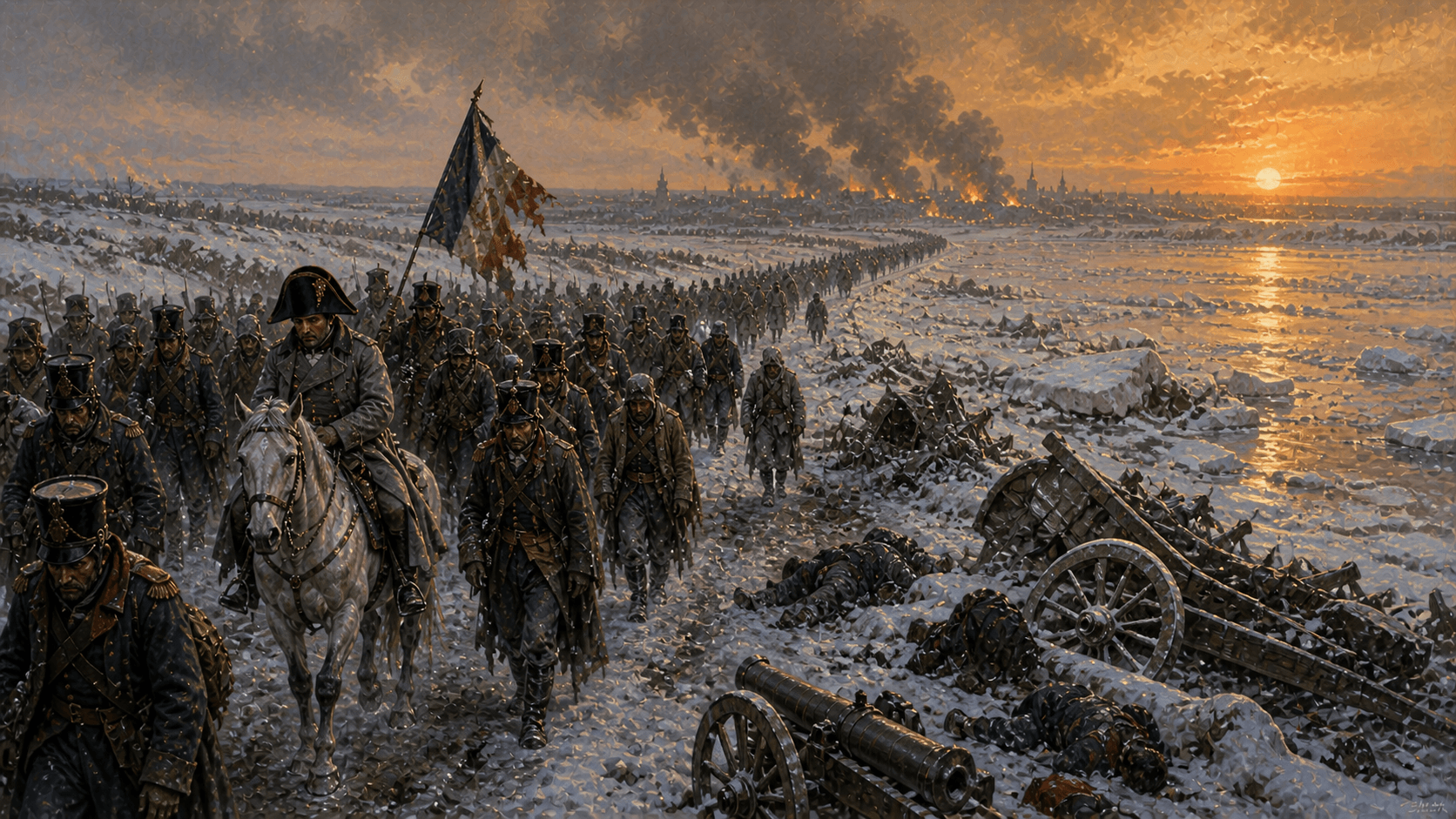
From that moment the retreat became a catastrophe on a scale that European history had never seen. The autumn rains turned roads to mud, then in early November the temperature fell dramatically. Men who had already marched hundreds of miles in disintegrating boots now walked through snow without adequate clothing. Horses collapsed and died in their thousands. Wagons were abandoned. The wounded were left behind. Discipline collapsed in units that had not eaten for days.
The Cossacks, fast, elusive, and merciless, harried the flanks and rear of the column constantly, cutting off stragglers, destroying detachments, and sowing terror in men too exhausted to fight effectively. The army moved in a long, straggling column of barely controlled misery, the Guard and the remaining organised units at its core, surrounded by tens of thousands of stragglers and civilian followers stumbling through the snow.
The Beresina river crossing in late November 1812 was the nadir. Russian forces had seized the main crossing and threatened to destroy what remained of the army entirely. Napoleon’s engineers, working in freezing water up to their shoulders, built two pontoon bridges under fire in a feat of extraordinary courage and technical skill. For three days the remnants of the Grande Armée crossed while French rearguards fought off Russian attacks on both banks. Thousands were killed in the fighting or drowned when bridges broke under the weight of fugitives. Thousands more were left on the eastern bank when the bridges were finally burned. Those who survived the Beresina still faced hundreds of miles through deepening winter to reach safety.
The Human Cost
The figures for the Russian Campaign are so extreme that they resist easy comprehension. Of the approximately 685,000 men who crossed the Niemen in June 1812, fewer than 100,000 returned to French-held territory in any effective condition. The remainder were dead from battle, from cold, from starvation, from disease, or were in Russian captivity. The losses in horses and artillery were proportionally as catastrophic, stripping Napoleon of the cavalry and gun park that had been central to his method of war.
These numbers include soldiers from every nation in Napoleon’s empire. The Polish corps, fighting for a country that did not yet exist, suffered terribly. The Prussian and Austrian contingents, whose governments were already calculating how long the alliance with France could be sustained, watched the disaster with a mixture of horror and quiet calculation. The German states that had supplied men and matériel to the campaign would not forget what their contingents had suffered.
Why It Mattered
The Russian Campaign did not immediately end Napoleon’s reign. He returned to Paris, suppressed a coup attempt by General Malet, and within months had assembled a new army from the conscript classes of 1813 and 1814. But it was never the same army. The veterans who had learned their trade in Italy, Egypt, and the great campaigns of 1805 – 1809 were gone, and their irreplaceable experience went with them. The new conscripts were brave enough but they could not yet match the hardened troops of Prussia and Russia in the mobile warfare that Napoleon’s system demanded.
More significantly, the news of the campaign’s catastrophe destroyed the myth of French invincibility that had been the foundation of Napoleon’s political control of Europe. Prussia broke its alliance with France in December 1812 and signed a convention with Russia at Tauroggen. By the spring of 1813 the Sixth Coalition was forming: Russia, Prussia, Austria, Britain, Sweden, and ultimately Spain united against France in a way they had never managed before. The 1813 campaign in Germany, the Battle of Leipzig and the final collapse in 1814, all flowed directly from the catastrophe of 1812. Without Russia, the empire might have endured for decades.
The Russian Campaign also had a profound effect on the subsequent history of European nationalism. Polish soldiers had fought and died in the belief that Napoleon would restore their country; he had used them and could not deliver. The German states that had served France unwillingly now had a common narrative of sacrifice and humiliation around which a national consciousness could form. In Russia itself the campaign produced an outpouring of patriotic feeling that would shape Russian identity for generations. The war that was meant to consolidate Napoleon’s empire instead began its dissolution.
Contemporary Voices
Arméd de Caulaincourt, Napoleon’s Master of Horse and ambassador to Russia, accompanied the Emperor throughout the campaign and wrote one of its most important firsthand accounts. In his memoir, published posthumously, Caulaincourt described the mood at headquarters as the army entered Moscow to find it burning and empty. He recorded that Napoleon was visibly shaken by the sight, pacing the Kremlin and alternating between disbelief and fury at Alexander’s refusal to negotiate. Caulaincourt had warned repeatedly, before the invasion, that Russia would not fight by the rules Napoleon expected. He understood the Russian character from his years in St Petersburg. Napoleon had listened and dismissed him.
During the retreat Caulaincourt was one of the small group who rode with Napoleon in a sleigh from the army to Paris after the Emperor decided, in early December, that his presence was needed in France. He described the silence of the journey, the Emperor’s grim acceptance, and Napoleon’s own analysis of where the campaign had gone wrong. It is a document of unusual psychological depth, written by a man who was close enough to the Emperor to observe him honestly and honest enough to record what he saw without the flattery that mars so many Napoleonic memoirs.
The soldier’s experience was recorded in dozens of diaries and letters, many of which only surfaced decades after the campaign. Sergeant Bourgogne of the Imperial Guard, whose memoirs are among the most vivid accounts of the retreat, described men burning their shakos for warmth, sharing a single biscuit among six, and stepping over bodies that had frozen solid in the road. The literature of the Russian Campaign is vast and still growing as previously unknown documents emerge from French and Russian archives.
Arméd de Caulaincourt, With Napoleon in Russia (1935, drawn from his manuscript memoir completed c.1822). Caulaincourt served as Master of Horse and Grand Equerry to Napoleon throughout the campaign and was among the handful who accompanied the Emperor on the final sleigh journey to Paris.
Further Reading
Primary Sources
- Caulaincourt, Arméd de – With Napoleon in Russia (manuscript c.1822, published 1935)
- Bourgogne, Sergeant – Mémoires du Sergent Bourgogne (1835)
- Ségur, Philippe-Paul de – History of Napoleon and the Grand Army during the Year 1812 (1825)
Modern Histories
- Zamoyski, Adam – 1812: Napoleon’s Fatal March on Moscow (2004)
- Lieven, Dominic – Russia Against Napoleon (2009)
- Chandler, David – The Campaigns of Napoleon (1966)
Book links, where present, may be affiliate links. As an Amazon Associate the Archive earns from qualifying purchases.