
The Battle of Salamanca
22 July 1812 · León, Spain
Background
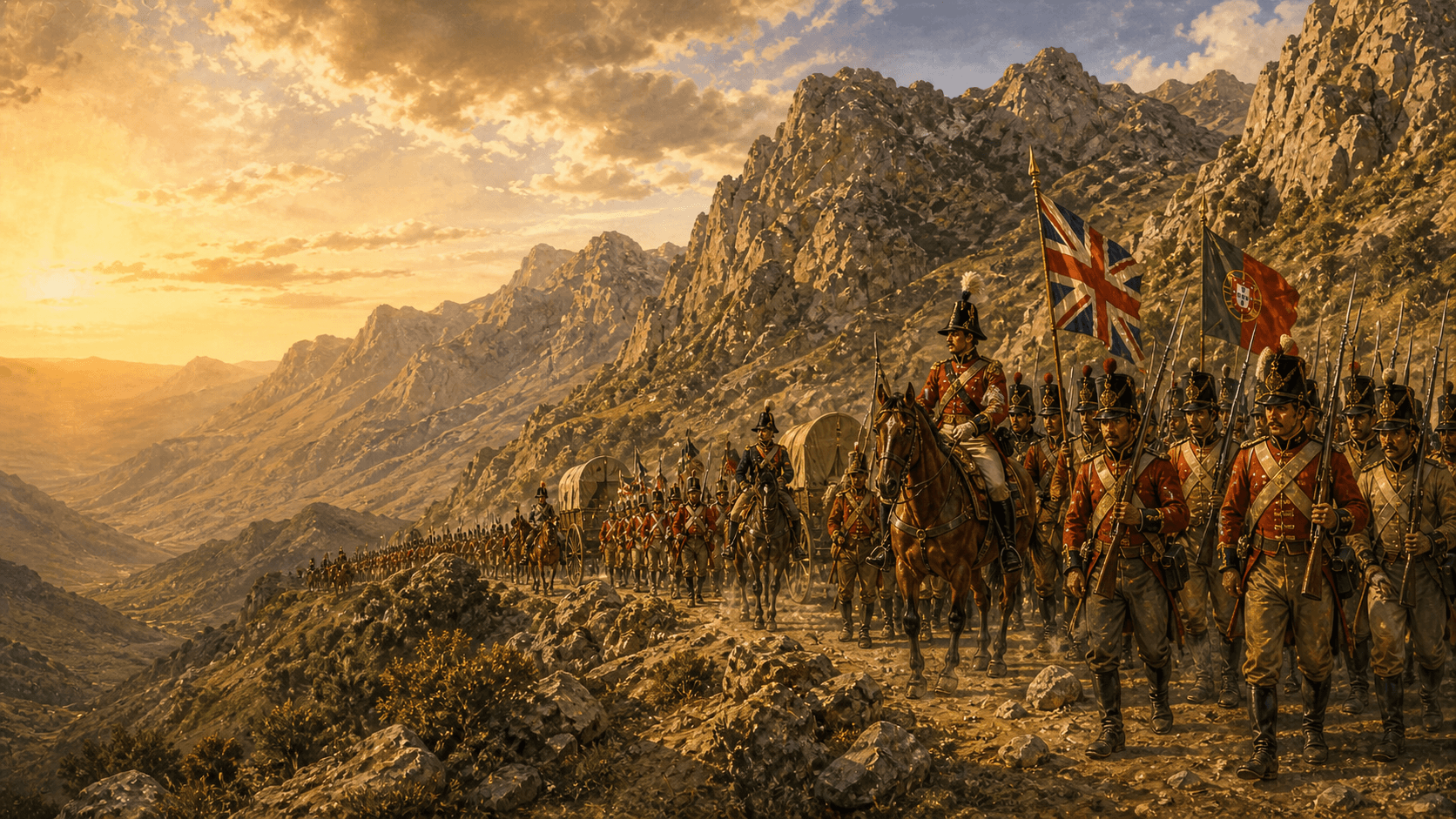
By the summer of 1812, Wellington had taken the frontier fortresses of Ciudad Rodrigo and Badajoz and was ready to advance into Spain. Marshal Marmont, commanding the French Army of Portugal, shadowed Wellington’s advance towards Salamanca. For nearly a fortnight the two armies manoeuvred in parallel, each looking for an opening, neither willing to attack at a disadvantage.
The watching and waiting tested the patience of both commanders. Wellington was criticised by his staff for excessive caution. Marmont, under pressure from Paris to produce results, grew increasingly impatient. On 22 July, Marmont saw what he believed was an opportunity: the Allied army appeared to be retreating, and he ordered his divisions to extend leftward to cut off Wellington’s line of march. It was the mistake Wellington had been waiting for.
The Armies
Allied
Under Wellington. British, Portuguese and Spanish divisions. Pakenham’s 3rd Division would deliver the decisive blow.
France
Under Marshal Marmont. Eight infantry divisions, two cavalry divisions. Well-equipped and experienced, but about to over-extend.
Wellington’s Moment
By Peninsular tradition, reported in the memoirs of General Alava and widely repeated since, Wellington was eating a cold chicken leg when his telescope showed him Marmont’s divisions extending to the left, opening a gap between his leading and trailing divisions. He is said to have flung down the chicken bone and exclaimed: “By God, that will do!” before spurring off to set the attack in motion.
Whether the exact words are authentic, the speed of Wellington’s response was extraordinary. Within minutes of spotting the over-extension, he had sent orders to Pakenham’s 3rd Division to attack the exposed head of the French column from the flank.
The Battle
Pakenham’s 3rd Division struck Thomières’s leading division in the flank and rear. The attack was devastating: Thomières was killed, his division shattered in minutes. The blow rolled along the French line from left to right as each division, strung out along the march route, was struck before it could form for battle.
Marmont himself was wounded early in the action by a shell splinter. Command passed first to Bonnet, who was also wounded almost immediately, and then to General Clausel, who attempted a counter-attack against Wellington’s centre. Clausel’s assault briefly threatened to stabilise the battle, but Wellington committed his reserves and the French line collapsed.
The pursuit through the evening and into the night completed the rout. French soldiers threw away their muskets and fled towards the fords of the Tormes. The Army of Portugal lost nearly half its strength in a single afternoon.
Casualties
Why It Mattered
Salamanca broke the French hold on central Spain. Within weeks, Wellington entered Madrid to a rapturous reception. The victory demonstrated that Wellington could attack as well as defend, that the supposedly invincible French system of war by column could be shattered by an army that moved faster and hit harder.
For the wider war, Salamanca changed the calculus of the Peninsular campaign. It proved that the French could not hold Spain against a British army that had learned how to manoeuvre offensively. The road from Salamanca led through Vitoria to the Pyrenees and ultimately to the invasion of France itself.
In Sharpe’s World
Fiction · Bernard Cornwell
Sharpe’s Sword is set during the Salamanca campaign. Sharpe hunts the French intelligence officer Colonel Leroux, a master swordsman who has been systematically destroying Wellington’s spy network. The battle itself provides the climax, with Sharpe wounded in the fighting on the Greater Arapile.
Buy Sharpe’s Sword →Further Reading
As an Amazon Associate I earn from qualifying purchases.