
The Siege of Seringapatam
4 May 1799 · Kingdom of Mysore, India
Background
The Fourth Anglo-Mysore War was triggered by Tippu Sultan’s alliance with Revolutionary France. Tippu had sent envoys to Mauritius seeking military support and had planted a “Tree of Liberty” in his capital. Governor-General Richard Wellesley judged that French reinforcements might arrive at any time and ordered an immediate campaign to destroy Mysore before the alliance could bear fruit.
General George Harris commanded the main army of approximately 20,000 men. Arthur Wellesley, then a colonel commanding the 33rd Foot and a brigade of Company troops, served as one of the key subordinate commanders. The march on Seringapatam took two months across the Deccan plateau.
The Armies
British & Company
Under General George Harris. Arthur Wellesley commanding reserves and the failed night attack of 5 April, later the successful assault on 4 May.
Kingdom of Mysore
Under Tippu Sultan. The fortress of Seringapatam was an island citadel on the River Kaveri, heavily fortified with modern ramparts and a substantial artillery park.
The Siege
The British invested Seringapatam in early April 1799. Siege batteries were established and the walls breached over several weeks of bombardment. On the night of 5 April, Wellesley led a force into a tope (grove of trees) near the fortress in an attempt to clear Mysorean outworks. The attack ended in confusion: his men became lost in the darkness, fired on each other, and were repulsed with casualties. It was the only significant military failure of Wellesley’s Indian career.
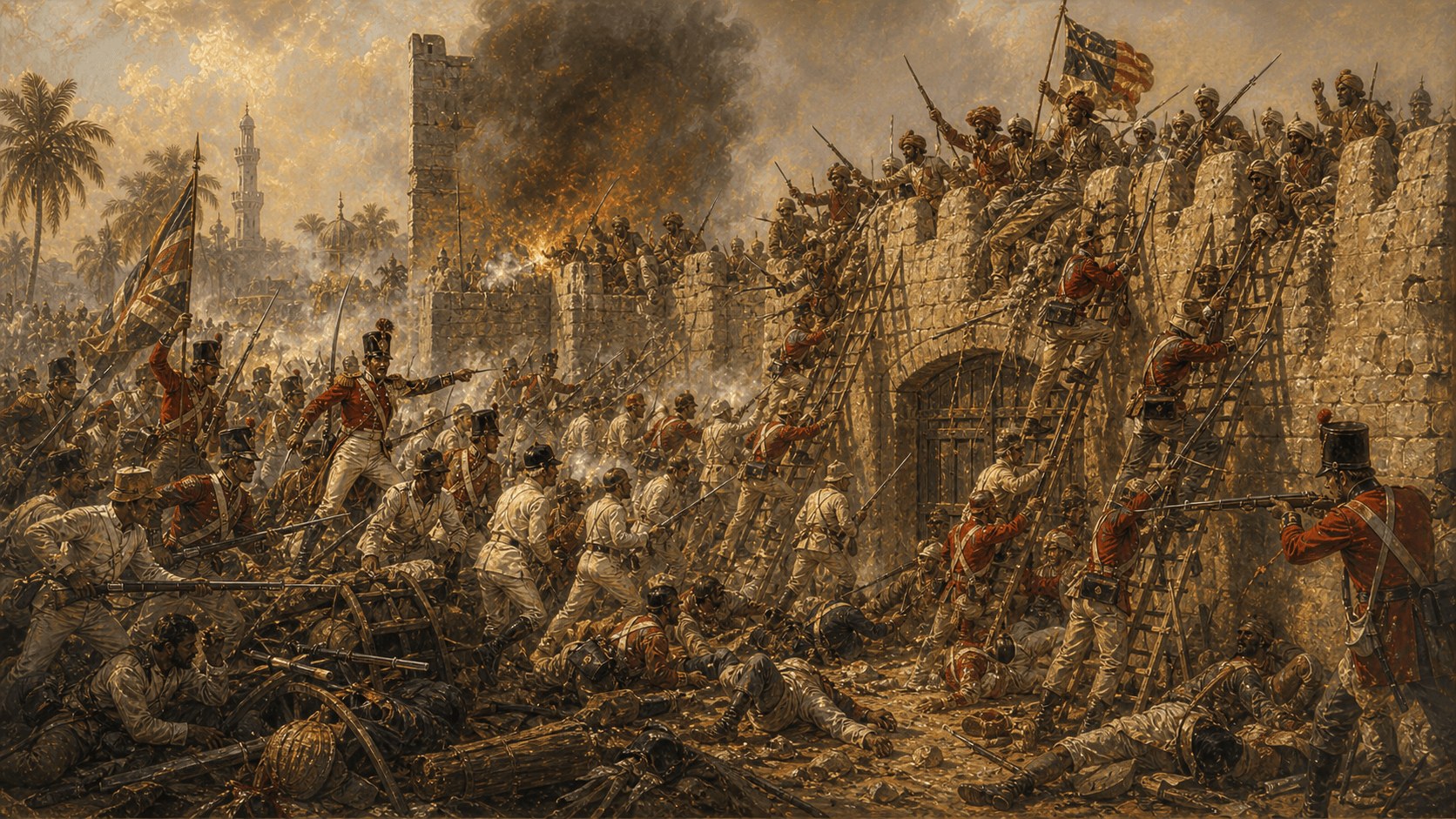
On 4 May the main assault was launched through two breaches in the walls. The storming parties fought through the breaches and into the fortified interior. Tippu Sultan was found dead among his soldiers near the northern gate; he had not surrendered and had been killed fighting. The sack of the city that followed lasted several hours before discipline was restored.
Wellesley was appointed governor of Seringapatam, his first experience of civil administration. He imposed order, suppressed looting, and governed the province with a mixture of firmness and pragmatism that prefigured his later administration of occupied territories in the Peninsula.
Casualties
Defender casualties are not reliably recorded in contemporary sources. Tippu Sultan was killed during the assault. The gap in Indian casualty records reflects how the Company documented its wars.
Why It Mattered
Seringapatam destroyed the Kingdom of Mysore, the last independent power in southern India capable of resisting Company expansion. It removed French influence from the subcontinent at a moment when Napoleon was campaigning in Egypt with ambitions to threaten British India. And it gave Arthur Wellesley his first experience of both command and civil governance.
The administrative skills Wellesley developed as governor of Seringapatam, feeding a province while pacifying guerrillas and managing local allies, were precisely the skills he would deploy across Portugal and Spain a decade later.
Wellington’s Failed Night Attack
On the night of 5 April, Wellesley led a force into a tope of trees in darkness and was repulsed in confusion: his men fired on each other and he was briefly separated from his command. It was the only significant military failure of his Indian career. He later said the experience taught him never to attack at night in difficult ground. This lesson informed his preference for defensive positions with clear fields of fire throughout the Peninsular War.
Sharpe’s Tiger
Fiction · Bernard Cornwell
Cornwell’s first Sharpe novel in chronological order. Private Richard Sharpe, serving in the 33rd Foot, is recruited for a clandestine mission inside the fortress of Seringapatam. The real siege and the death of Tippu Sultan form the backdrop; Sharpe’s mission inside the fortress is Cornwell’s invention. The historical detail, including Wellesley’s failed night attack and the storming of the breach, is closely researched.
Buy Sharpe’s Tiger →Tippu Sultan
The Tiger of Mysore. The Company’s greatest Indian opponent, who modernised his army with French advisers, deployed iron-cased rockets, fortified Seringapatam, and sought alliances with Napoleon. He was killed fighting at the northern gate of his fortress on 4 May 1799, aged forty-eight.
Further Reading
As an Amazon Associate I earn from qualifying purchases.