
The Napoleonic Archive
The NapoleonicArchive
The Napoleonic Archive

India & the East India Company

1757 to 1858 · Where Wellington was forged and Sharpe began

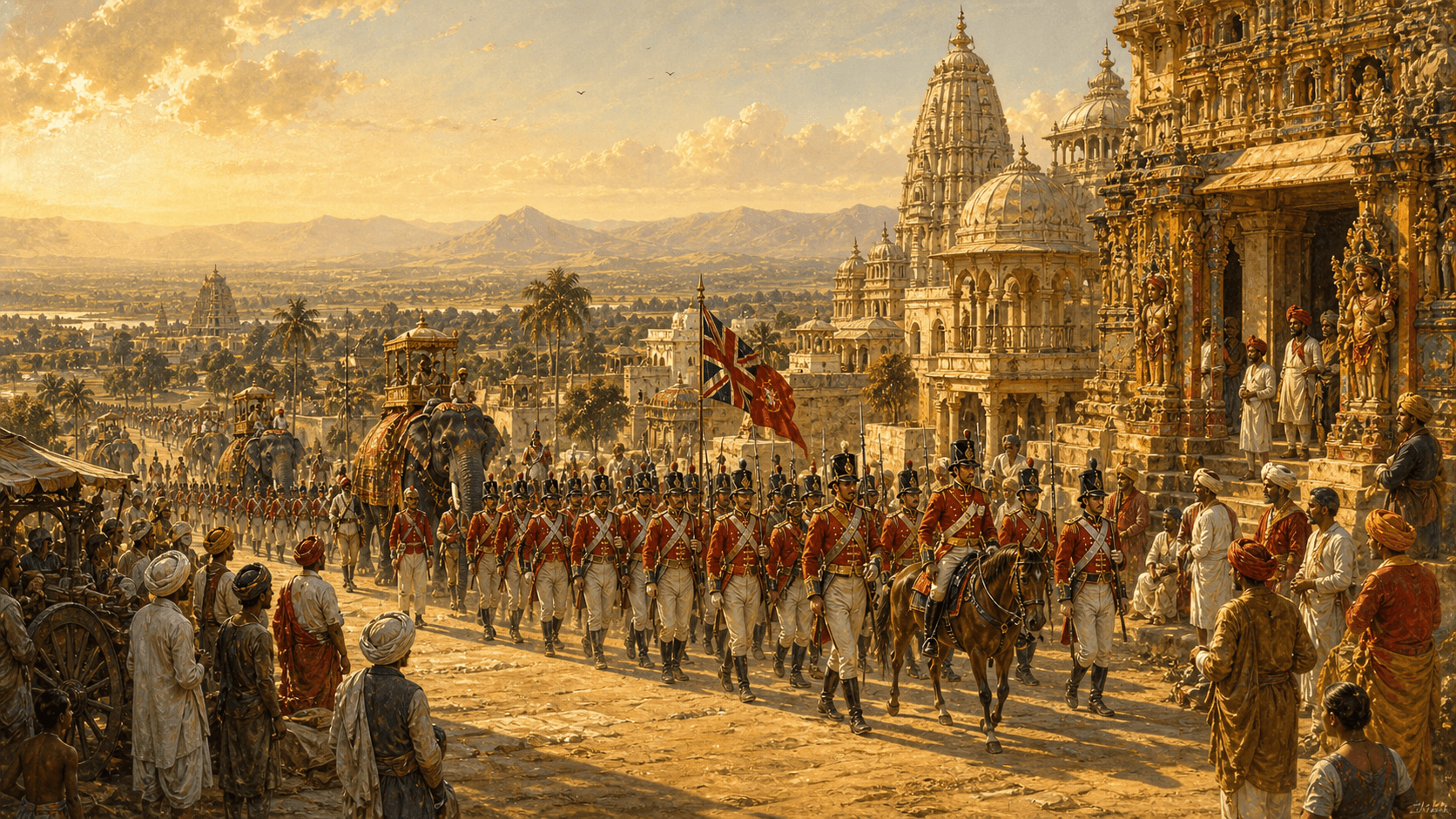
British and Indian forces in the subcontinent

India is the hidden foundation of the Napoleonic wars. The East India Company controlled vast territories with its own private army, larger than most European states could field. It was in India that Arthur Wellesley arrived in 1797, an undistinguished younger son with a purchased commission, and left in 1805 as one of Britain’s most experienced and successful generals. The campaigns he fought there, at Seringapatam, Assaye, Argaum and Gawilghur, gave him the methods and the reputation he would carry into the Peninsula and ultimately to Waterloo.

This is also where Richard Sharpe’s story begins. The first three Sharpe novels are set in India, and they show the Company’s world through the eyes of a private soldier: sepoys, nabobs, fortresses, and the collision of European and Indian military traditions.

The Campaigns

Wellington’s Indian wars · 1799 to 1803

Siege of Seringapatam

4 May 1799 · Mysore
Forces ~20,000 British & Company vs ~30,000 Mysorean
British casualties ~1,400
Outcome Decisive British victory

Defender casualties are not reliably recorded in contemporary sources. Tippu Sultan was killed during the assault.

The Fourth Anglo-Mysore War ended with the storm of Tippu Sultan’s island fortress at Seringapatam. The British breached the walls after a month-long siege and stormed the fortress on 4 May. Tippu Sultan was killed fighting at the northern gate. Arthur Wellesley commanded a reserve column during the assault and was afterwards appointed governor of the captured city, where he demonstrated the administrative ability that would later sustain his Peninsular campaigns.

In Sharpe: Sharpe’s Tiger

Battle of Assaye

23 September 1803 · Deccan
Forces ~7,000 British vs ~40,000 Maratha
British casualties ~1,600 (nearly a quarter of his force)
Outcome British victory (costly)

Maratha casualties are estimated at approximately 6,000 but contemporary Indian sources are limited and figures vary significantly between historians.

Wellington attacked a Maratha army that outnumbered him roughly five to one because he judged, correctly, that the ground between the rivers Kaitna and Juah would channel the enemy’s numerical advantage. The fighting was ferocious. Two horses were shot under Wellington and his orderly was killed at his side. He later called Assaye the bloodiest battle he had ever seen, a verdict he maintained even after Waterloo. The victory shattered Scindia’s army and opened the Deccan to Company expansion.

Battle of Argaum

29 November 1803 · Berar
Forces ~11,000 British vs ~30,000 Maratha
British casualties ~350
Outcome Decisive British victory

Maratha casualties estimated at approximately 5,000 but not reliably documented in contemporary sources.

A month after Assaye, Wellington confronted and destroyed a second Maratha army at Argaum (also known as Adgaon). This was a more decisive and less costly engagement than Assaye: the Maratha force, drawn mainly from the Bhonsle of Nagpur’s army, broke under British volleys and a cavalry charge. The victory completed the destruction of the Berar army and cleared the way for the assault on Gawilghur.

Storm of Gawilghur

15 December 1803 · Deccan
Forces ~11,000 British (assault)
British casualties ~150 killed and wounded
Outcome Fortress taken

Defender casualties were not recorded by British sources. The gap in the historical record reflects how the Company documented its wars.

Gawilghur was a seemingly impregnable hill-fortress perched on a cliff above the Deccan plateau, protected by ravines and massive walls. Wellington coordinated simultaneous attacks on the outer and inner works from two separate columns. The fortress fell in a single day. Its capture effectively ended the Second Anglo-Maratha War and confirmed Company dominance across central India.

Key Figures

Arthur Wellesley

1769-1852
Major-General, later Duke of Wellington

Arrived in India in 1797 as an undistinguished younger son with a purchased commission. His brother Richard’s patronage gave him independent commands. Seringapatam, Assaye and Gawilghur transformed him into one of Britain’s most experienced and successful generals. He left India in 1805 and carried its lessons to Portugal, Spain and Waterloo.

Richard Wellesley, Marquess Wellesley

1760-1842
Governor-General of India, 1798-1805

The aggressive expansionist who doubled the Company’s territory through the Subsidiary Alliance system: Indian rulers accepted Company garrisons, paid for by the ruler, commanded by Company officers. Those who refused were attacked. He gave his brother the military commands that made him, and was recalled to London in 1805 amid controversy over the cost and scale of his wars.

Tippu Sultan

1750-1799
Sultan of Mysore · The Tiger of Mysore

The Company’s greatest Indian opponent and the last ruler to pose a serious military threat to British expansion in southern India. He modernised his army with French advisers, deployed iron-cased rockets (which influenced British rocket development), fortified Seringapatam, and sought alliances with Napoleon against the British. He was killed fighting at the northern gate of his fortress during the final storm on 4 May 1799.

Read full profile →

The Maratha Confederacy

c.1674-1818
The dominant Indian power after Mughal decline

A loose confederacy of Hindu warrior states that filled the power vacuum left by the Mughal Empire’s collapse. At their peak the Marathas controlled much of central and western India. Their armies, trained by European mercenaries and equipped with modern artillery, were the most formidable the Company faced. Wellington defeated them at Assaye, Argaum and Gawilghur in the Second Anglo-Maratha War (1803-05), breaking their military power and opening India to Company dominance.

Sharpe in India

Bernard Cornwell · The India Novels

Sharpe's Tiger

Seringapatam, 1799

Private Sharpe slips into Tippu Sultan's fortress on a clandestine mission and earns his first stripe.

Buy on Amazon →

Sharpe's Triumph

Assaye, 1803

Sergeant Sharpe fights at Wellesley's side and commits the act that wins him a commission.

Buy on Amazon →

Sharpe's Fortress

Gawilghur, 1803

Newly-commissioned Ensign Sharpe climbs the cliff-fortress against both Mahratta guns and the gentlemen of his own regiment.

Buy on Amazon →

India in 1797: A Continent in Flux

When Arthur Wellesley arrived in India in 1797, the Mughal Empire was a hollow shell. The Emperor in Delhi was a pensioner of the Marathas, who controlled much of central and western India. In the south, Tippu Sultan held Mysore with French military advisers and nursed ambitions of driving the British into the sea. The Nizam of Hyderabad, the Nawab of Oudh, and dozens of smaller rulers played the European powers against each other.

The French connection was real and alarming. Napoleon’s Egyptian campaign of 1798 was partly aimed at threatening British India, and Tippu Sultan had openly corresponded with the French Directory seeking an alliance. The Company’s wars in India were not separate from the wider Napoleonic struggle: they were the eastern front of a global contest for supremacy.

Empire and Exploitation

The Company’s record cannot be separated from its human cost. The Bengal famine of 1770 killed an estimated ten million people, approximately one third of the province’s population, and was exacerbated by the Company’s insistence on collecting land revenue even as crops failed. The Indian textile industry, once the finest in the world, was systematically undermined: Bengali weavers were forced to sell at fixed prices while British manufactured goods were imported duty-free.

The opium trade was cultivated under Company monopoly in Bengal and sold into China through private merchants, generating enormous profits. Forced cultivation of indigo displaced food crops. The historian William Dalrymple has characterised the Company as a corporate state that pioneered the techniques of aggressive colonial expansion. The economist Utsa Patnaik has estimated the total drain of wealth from India to Britain at $45 trillion in modern terms, though this figure and methodology are disputed by other historians.

The historical debate continues. Some historians note that the Company built roads, codified laws, and created institutions that outlasted it. Others argue that these achievements were incidental to exploitation. An honest account must acknowledge both the scale of the destruction and the complexity of the legacy.

Taboo (BBC/FX, 2017)

Tom Hardy’s television series is set in 1814 and shows the East India Company’s London face: the boardroom of East India House on Leadenhall Street, the political corruption that reached into Parliament, and the ruthlessness with which the Company defended its monopolies. The series depicts the Company as willing to use assassination, bribery, and state violence to protect its commercial interests, particularly in the lucrative China trade.

Taboo is fiction, and takes considerable dramatic liberties with both plot and chronology. But its portrayal of the Company as a corporate power with sovereign ambitions, operating at the intersection of commerce and government, is rooted in historical reality. The Company did maintain its own intelligence network, did influence parliamentary votes, and did use force to protect its monopoly system. For anyone interested in the Company’s domestic political power, rather than its military campaigns in India, Taboo is a useful and atmospheric companion piece.

Why India Matters

India shaped Wellington. The eight years he spent there, from 1797 to 1805, taught him logistics, the management of sepoy armies, the importance of supply, and the decisive value of personal reconnaissance. His tactics at Assaye (attacking an army five times his size because he judged the ground correctly) and his administration of Mysore (feeding a province while running a war) were the rehearsal for everything that followed in Portugal and Spain.

Without India there would have been no Peninsular War as we know it, no Waterloo, and no Sharpe. The Company’s wars produced the general who defeated Napoleon. That story begins here.

Further Reading

The Anarchy

William Dalrymple, 2019

The definitive modern account of the East India Company’s rise from a London trading venture to a corporate sovereign ruling a subcontinent. Dalrymple draws on Indian, Persian and Company sources to tell the story from all sides.

Browse all resources →

As an Amazon Associate I earn from qualifying purchases.