
The Battle of Corunna
16 January 1809 · The Retreat That Became a Legend
Background
In the autumn of 1808, Sir John Moore led a British army of approximately 30,000 men into Spain to support the Spanish uprising against Napoleon. When Napoleon himself arrived in Spain with massive reinforcements and smashed the Spanish armies, Moore found himself isolated deep in enemy territory. He had no choice but to retreat to the coast, to the port of Corunna (La Coruña) in Galicia, where the Royal Navy could evacuate him.
The Retreat
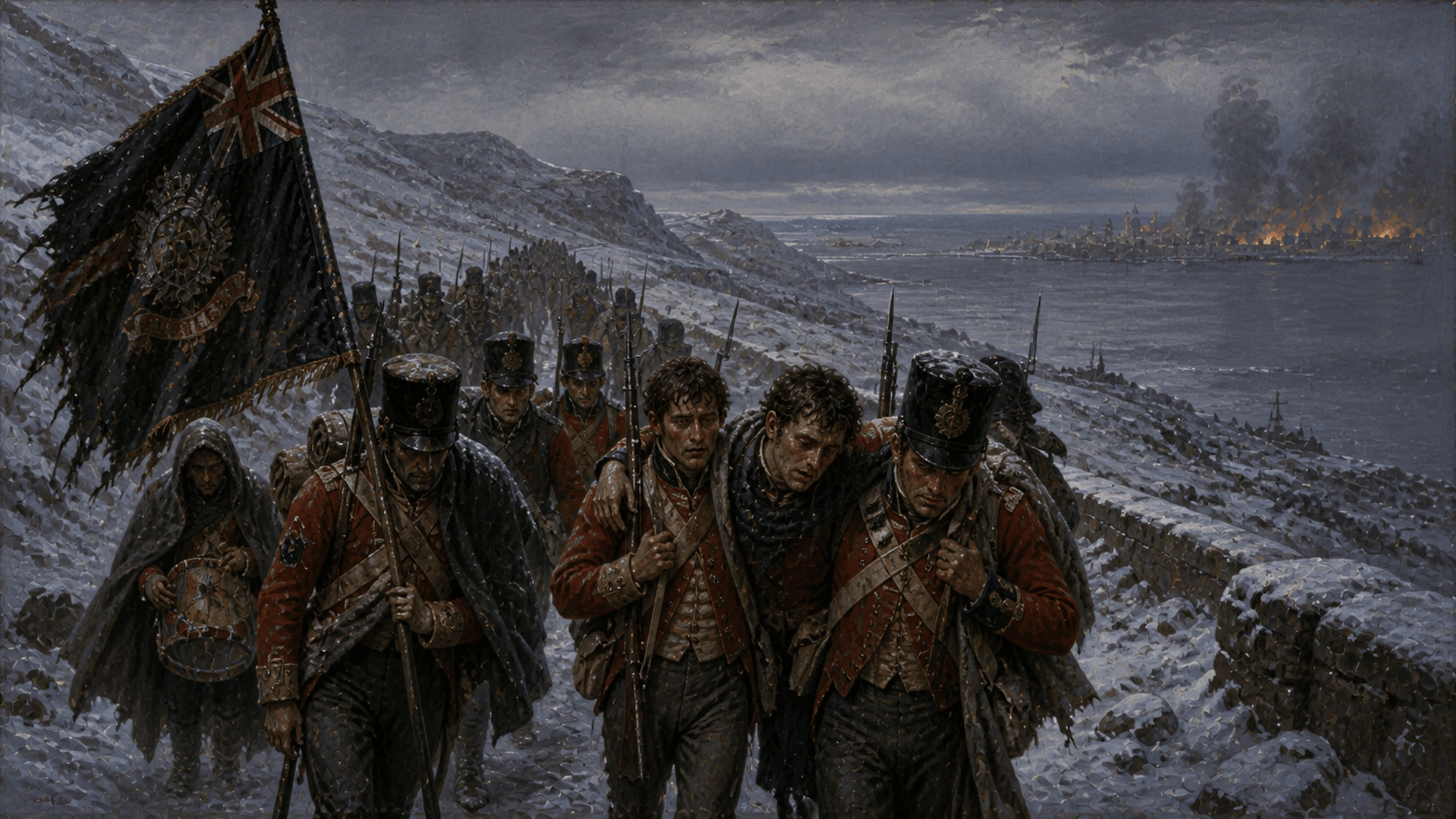
The retreat to Corunna was one of the most harrowing episodes of the Napoleonic Wars. Moore’s army marched through the mountains of Galicia in the depths of winter, pursued by Marshal Soult. The roads were rivers of ice. Men collapsed from exhaustion and cold. Discipline broke down: soldiers broke into wine stores and drank themselves to death. Women and children with the army died by the roadside.
Benjamin Harris of the 95th Rifles left the most vivid account of the retreat. He describes the blistered feet, the raw oxhide tied around ruined shoes, the bodies in the snow, and the French dragoons picking off stragglers. It is one of the most powerful eyewitness accounts in the memoir literature of the period.
The Battle
On 16 January 1809, with the transport ships finally in the harbour, Moore turned his army to fight. The battle was a rearguard action fought on the heights above Corunna to cover the embarkation of the army. The British infantry, despite their exhaustion, fought with discipline and determination. Soult’s attacks were repulsed across the line. It was a clear tactical victory.
The Death of Moore
Sir John Moore was struck by a cannonball on the ridge above the port during the battle. The ball shattered his left shoulder and ribs. He was carried to the rear and died that evening. His last words, reported by his aide-de-camp Captain Stanhope, included the wish that his country would do him justice.
Moore was buried at midnight on the ramparts of Corunna, wrapped in his military cloak. Charles Wolfe’s poem “The Burial of Sir John Moore after Corunna” (1817), which begins “Not a drum was heard, not a funeral note,” became one of the most famous poems of the Romantic period and ensured that Moore’s death passed into British legend.
The Embarkation
The army successfully embarked during the night and the following day. Approximately 26,000 men were evacuated to Britain. The retreat had cost approximately 6,000 men from all causes: battle, disease, exhaustion and desertion. But the army had been saved, and Moore had left Iberia free for Wellesley’s return later that year.
Casualties
In Sharpe’s World
Sharpe’s Rifles opens in the retreat to Corunna. This is where Sharpe first meets Patrick Harper, where the chosen men are formed, and where the 95th’s Peninsular story begins. The retreat is the crucible that forges Sharpe’s company.
Sharpe’s Rifles →Harris on Corunna
Benjamin Harris’s Recollections provide the most vivid private-soldier account of the retreat. His descriptions of the suffering, the cold, the breakdowns and the small moments of human decency make the retreat real in a way no officer’s dispatch can.
As an Amazon Associate I earn from qualifying purchases.