
The Hundred Days
1 March – 22 June 1815 · Napoleon’s Last Campaign
What Were the Hundred Days?
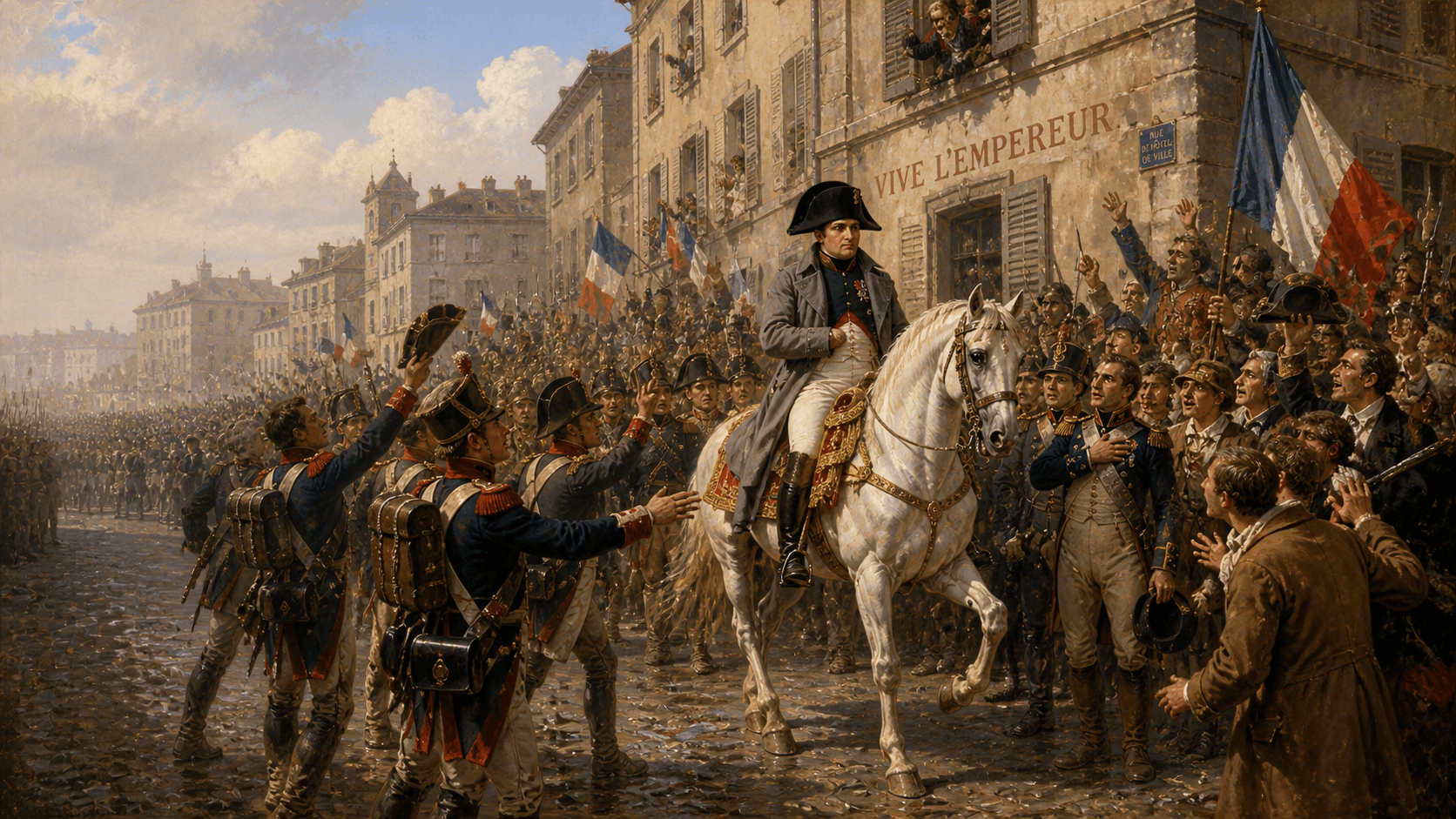
The Hundred Days is the name given to the period between Napoleon’s escape from exile on Elba on 1 March 1815 and his second abdication on 22 June 1815. In 111 days, Napoleon returned to France, reclaimed the throne, rebuilt his army, and fought a final campaign that ended in the most famous battle in European history.
The Escape from Elba
Napoleon left Elba with approximately 1,000 men on 26 February 1815. He landed in the south of France on 1 March and began marching north towards Paris. Louis XVIII sent troops to arrest him. At Laffrey, near Grenoble, Napoleon walked towards the soldiers sent to stop him, opened his coat, and invited them to shoot their Emperor. They joined him. Regiment after regiment went over to Napoleon. Marshal Ney, who had promised to bring Napoleon back to Paris in an iron cage, marched to join him instead. Louis XVIII fled. On 20 March, Napoleon entered Paris.
The Army Reassembles
Napoleon rebuilt his army with extraordinary speed. Within weeks he had assembled approximately 125,000 men, the Armée du Nord, equipped, trained and ready to fight. The loyalty of the French army to Napoleon personally, despite the disasters of 1812-1814, was remarkable. These were veterans who believed in their Emperor. Many had served him for a decade or more.
The Allied Response
The European powers, meeting at the Congress of Vienna, declared Napoleon an outlaw and formed the Seventh Coalition. Wellington was appointed to command the Allied army in Belgium: a mixed force of British, Dutch-Belgian, Hanoverian and other German troops. Blücher commanded the Prussian army to Wellington’s east. Together they would face Napoleon in Belgium.
Ligny: 16 June 1815
Napoleon struck first, crossing the border into Belgium on 15 June. On 16 June he defeated Blücher’s Prussians at Ligny, the last battle Napoleon would ever win. The Prussian centre broke at evening when the Old Guard stormed the village. Old Blücher was ridden over in a cavalry mêlée and lay under his dead horse until darkness.
But the Prussians withdrew in good order, northward towards Wavre rather than eastward towards their supply lines. This decision, largely the work of Gneisenau, Blücher’s chief of staff, kept the Prussian army in contact with Wellington. It would prove decisive.
Quatre Bras: 16 June 1815
On the same day, Ney attacked Wellington’s position at the crossroads of Quatre Bras. The fighting was fierce, in fields of head-high rye, but Ney failed to seize the junction before Wellington could concentrate his forces. A missed opportunity: if Ney had taken Quatre Bras, Wellington would have been cut off from Blücher.
The Two Days Between
On 17 June, Wellington retreated from Quatre Bras to a position he had reconnoitred months earlier: the ridge of Mont-Saint-Jean, south of the village of Waterloo. Blücher retreated to Wavre and promised to march to Wellington’s aid. Napoleon sent Grouchy with 33,000 men to pursue the Prussians, but Grouchy pursued too slowly and in the wrong direction. The stage was set.
Waterloo: 18 June 1815
Nine hours of slaughter on a two-mile front. The details are on the dedicated Waterloo page. What matters here is the result: the Imperial Guard was broken, the French army collapsed, and Napoleon’s last campaign was over.
The Aftermath
Napoleon returned to Paris and abdicated for the second time on 22 June. He surrendered to the British on 15 July, boarding HMS Bellerophon. The Allies exiled him to St Helena, a remote island in the South Atlantic, where he died on 5 May 1821. The Hundred Days were over. The Napoleonic era was finished.
In Sharpe’s World
Sharpe’s Waterloo covers the entire Hundred Days campaign. Sharpe is attached to the Prince of Orange’s staff as a liaison officer, giving him a front-row seat to the incompetence and heroism of the final battle.