
The Battle of Austerlitz
2 December 1805 · Moravia
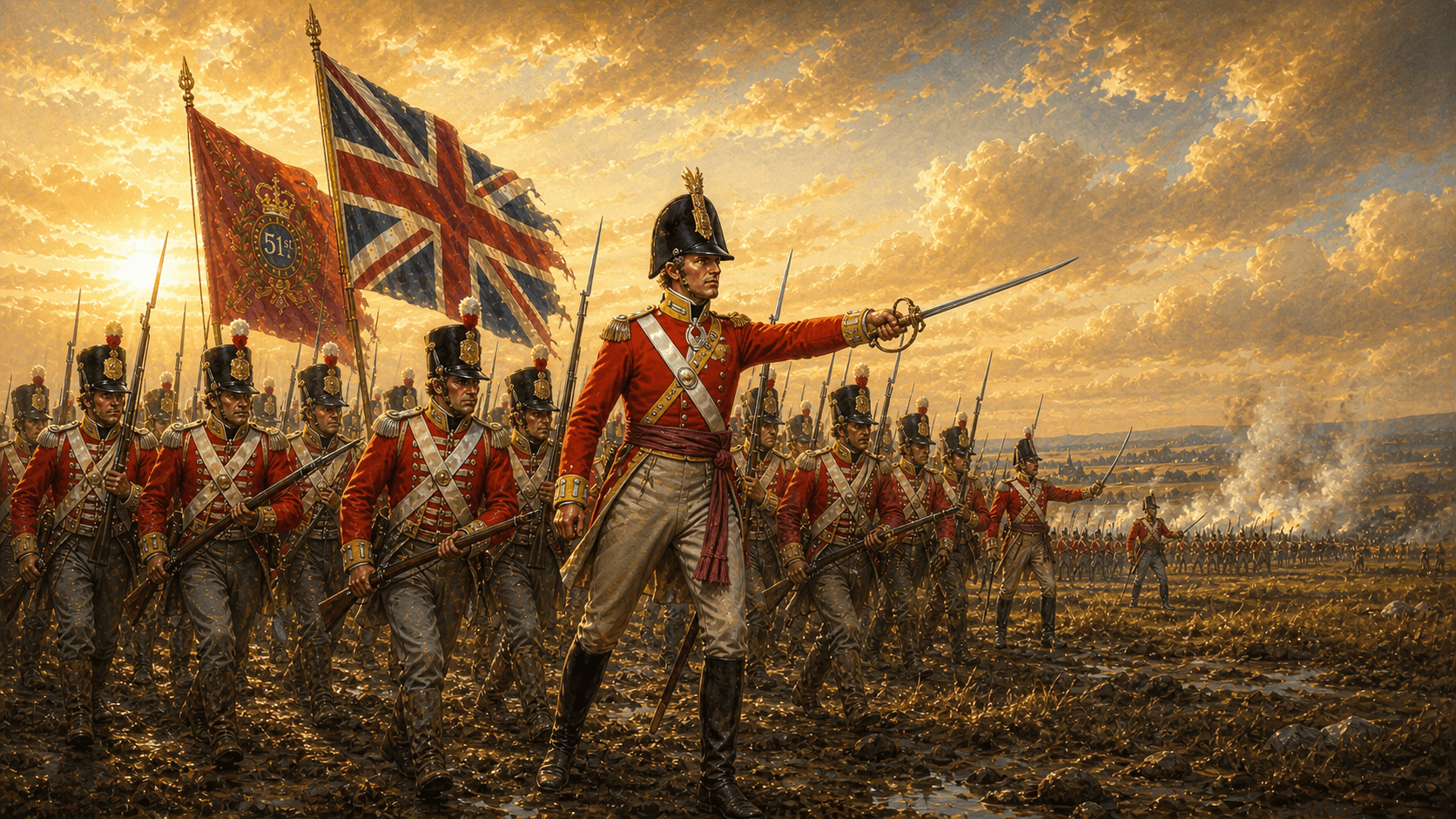
Background
After the destruction of the Austrian army at Ulm in October 1805, Napoleon marched east to confront the combined forces of Russia and Austria. The Third Coalition, formed to contain French expansion, had united the two eastern empires against France. Tsar Alexander I and Emperor Francis II of Austria were both present with their armies, making the confrontation uniquely personal.
Napoleon occupied Vienna without a fight but his position was precarious. His lines of communication stretched back to France across hundreds of miles. A Russian army under Kutuzov had escaped the Ulm disaster and was being reinforced. Napoleon needed a decisive battle before winter and before Prussia could join the Coalition against him.
The Armies
France
Under Napoleon. Veterans of the Boulogne camp, the finest army France ever fielded. Soult, Lannes, Bernadotte, Murat commanding the corps.
Russia & Austria
Under Tsar Alexander I and nominally Kutuzov. Austrian contingent under Emperor Francis II. Numerically superior but divided by national jealousy and overconfidence.
Napoleon’s Plan
Napoleon deliberately weakened his right flank, inviting the Allies to attack it. He wanted them to commit their main strength to an assault on the Goldbach stream below the Pratzen Heights, drawing forces away from the Heights themselves. The Pratzen was the key to the battlefield: whoever held it dominated the entire field.
The plan required precise timing. Davout’s corps, marching from Vienna, had to arrive in time to reinforce the weakened right flank and hold long enough for the decisive stroke. The decisive stroke itself would be delivered by Soult’s corps, hidden in the mist below the Pratzen Heights, launched at the exact moment when the Allied centre was stripped to feed their left-flank attack.
The Battle
The battle began in thick fog at dawn. As Napoleon had intended, the Allies launched a massive attack on his right, sending five columns south across the Goldbach. Davout’s corps, arriving after a forced march, held the line at Telnitz and Sokolnitz in bitter fighting.
By mid-morning the fog lifted, revealing the Pratzen Heights stripped of most of their defenders. Napoleon gave the order and Soult’s two divisions stormed the Heights. The seizure of the Pratzen cut the Allied army in two: the forces attacking the French right were now isolated, and the Allied centre was shattered.
The Allies attempted counter-attacks on the Pratzen but were repulsed by Soult’s infantry and the Imperial Guard. On the Allied left, the retreating columns were driven onto the frozen Satschan ponds. French artillery fired into the ice, and soldiers, horses and guns plunged into the freezing water. The rout was complete by mid-afternoon. Tsar Alexander fled the field in tears.
Casualties
Why It Mattered
Austerlitz destroyed the Third Coalition. Austria sued for peace within days, signing the Treaty of Pressburg which stripped her of her Italian and German possessions. The Holy Roman Empire, a thousand years old, was formally dissolved the following year. Russia retreated eastward. Prussia, which had been wavering, was left to face Napoleon alone in 1806.
Austerlitz was Napoleon’s masterpiece, the battle by which all subsequent Napoleonic engagements were judged. The combination of deception, timing, and the exploitation of a single decisive point was never surpassed. On its first anniversary, Napoleon issued a proclamation to his soldiers: the date, 2 December, remained sacred to the Empire.
Further Reading
As an Amazon Associate I earn from qualifying purchases.