The Napoleonic Archive
The NapoleonicArchive

95th Regiment of Foot

The Rifle Brigade · Swift and Bold · Sharpe’s Regiment

Raised
1800
Uniform
Green jacket
Weapon
Baker Rifle
Motto
Celer et Audax

Introduction

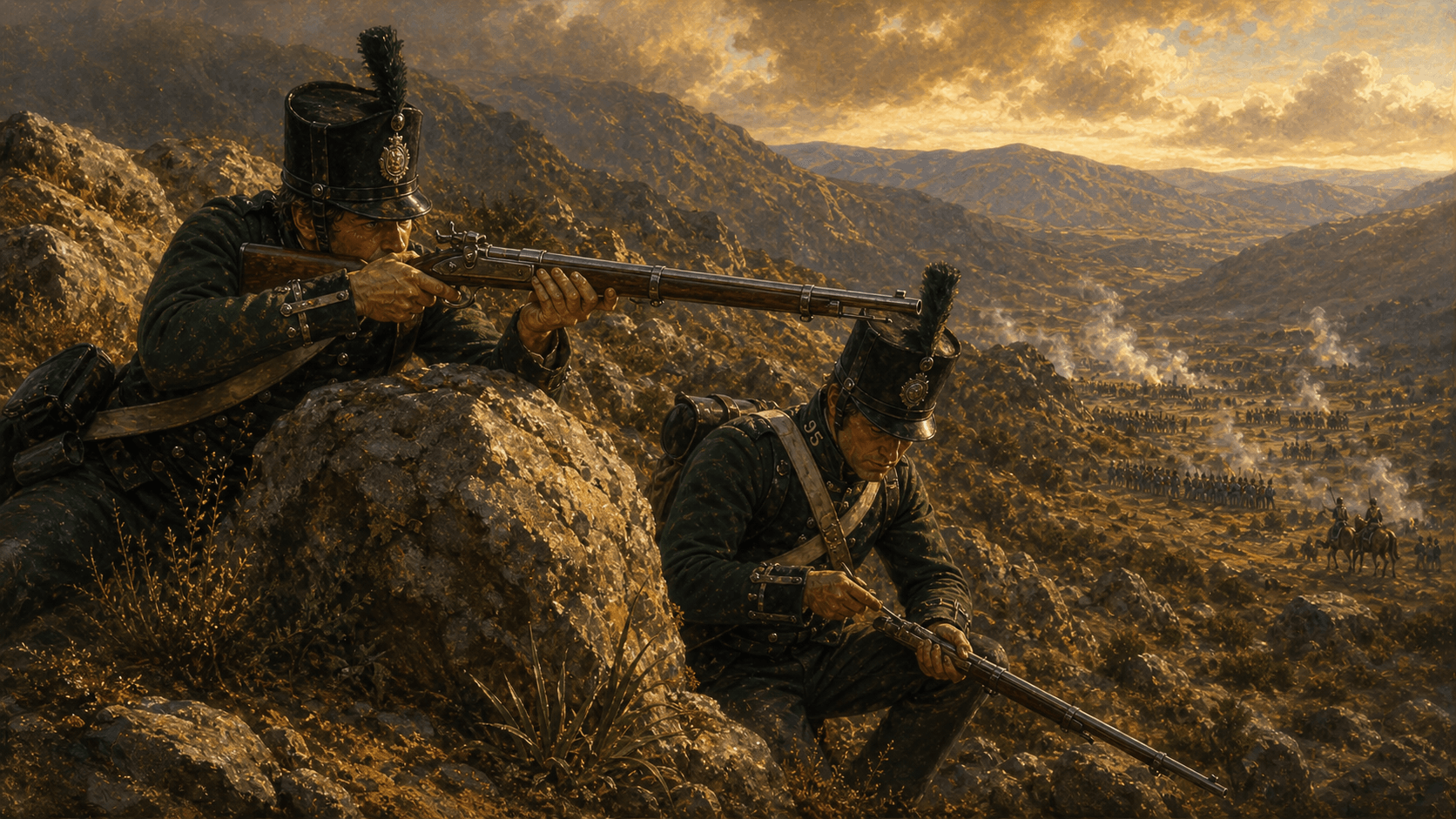
The 95th Rifles were unlike any other regiment in the British Army. Where line infantry stood shoulder to shoulder in rigid formation and traded volleys at fifty yards, the riflemen fought in pairs, using cover, thinking independently, and shooting accurately at three times the range of the standard musket. Armed with the Baker rifle and clothed in dark green instead of the regulation scarlet, they were the most feared light infantry in Europe.

They are also Richard Sharpe’s regiment. The green-jacketed 95th is the home of Bernard Cornwell’s hero and of Sergeant Patrick Harper, the big Irishman with the seven-barrelled volley gun. In fiction and in fact, the 95th Rifles defined a new kind of soldier: skilled, self-reliant, and deadly at range.

Raising the Regiment

The regiment was founded in 1800 as the Experimental Corps of Riflemen under Colonel Coote Manningham and Lieutenant Colonel William Stewart. It drew volunteers from across the army: men who could shoot, think, and act on their own initiative. From the beginning it was conceived as an elite.

The training system that shaped the 95th was developed at Shorncliffe Camp in Kent under Sir John Moore. Moore’s methods emphasised individual initiative, marksmanship, fitness, and a relationship between officers and men that was closer and more respectful than in the line regiments. The soldiers were armed with the Baker rifle, a grooved, muzzle-loading weapon accurate to 300 yards, against the 50 to 75 yards effective range of the standard Brown Bess musket. They wore dark green jackets chosen for concealment, with black leather accoutrements: no bright brass buttons or white crossbelts to catch the light or the eye of an enemy marksman.

The Baker Rifle

The Baker rifle, designed by Ezekiel Baker of Whitechapel and adopted in 1800, was the weapon that made the 95th what they were. Its barrel was shorter than the Brown Bess musket and had seven quarter-turn grooves that spun the ball, giving it far greater accuracy at range. The cost was speed: the tight-fitting ball had to be hammered down the grooved barrel with a mallet, making the Baker slower to load than a smoothbore musket. A trained rifleman could fire two aimed shots per minute; a line infantryman with a Brown Bess could manage three or four unaimed volleys.

The trade-off was deliberate. The 95th were not expected to deliver massed fire. They were expected to pick off officers, sergeants, artillerymen and colour-bearers at ranges where the enemy could not reply. The best shots in each company were designated “Chosen Men” and given a distinguishing badge: they were the elite of an elite, trusted to select their own targets and fire independently.

The Baker was fitted with a sword bayonet rather than the triangular spike bayonet of the line infantry. At 24 inches, it was longer than the standard bayonet and could be used as a short sword in close quarters. The rifleman was expected to be as dangerous with the blade as with the ball.

Effective range
Baker: 200 to 300 yards
Brown Bess: 50 to 75 yards
Rate of fire
Baker: 2 aimed shots/min
Brown Bess: 3 to 4 volleys/min
Barrel
Baker: Rifled (7 grooves)
Brown Bess: Smoothbore

Tactics and Training

Riflemen fought in pairs. While one loaded, the other aimed, ensuring that at least one rifle was always ready. The pair moved together, used cover instinctively, and operated with a degree of autonomy unknown in the line regiments. They were expected to read the ground, choose targets, and act without waiting for orders.

Use of cover was revolutionary in an era when British line infantry stood upright in formation as a matter of regulation and pride. The 95th lay down behind walls, fired from copses, and crawled through standing crops to reach a firing position. NCOs and even privates were trained to act on their own initiative, a doctrinal shift that owed everything to Sir John Moore’s Shorncliffe system.

In place of the rolling drumbeats that controlled line infantry manoeuvres, the 95th used bugle calls. The bugle carried further over broken ground and through the noise of battle, and it suited a regiment whose soldiers were often scattered as skirmishers. They fought ahead of the main line, harassing enemy columns, picking off officers, and disrupting formations before the main British line ever came into volley range. Where a line regiment stood and fired in unison, the rifleman moved, thought, and chose his target.

The Campaigns

  1. 1807

    Copenhagen

    The 95th took part in the British expedition that bombarded Copenhagen and seized the Danish fleet.

  2. 1808-09

    Corunna

    The harrowing winter retreat across Galicia. Riflemen of the 95th formed the rearguard under Sir John Moore.

  3. 1810

    Busaco

    The 95th skirmished ahead of Wellington's line on the ridge of Busaco, blunting the French advance before the main engagement.

  4. 1812

    Ciudad Rodrigo

    A midwinter siege opened in frozen trenches. The 95th provided sharpshooters and assault troops at the breaches.

  5. 1812

    Badajoz

    The most costly night in the regiment's history. The 95th led storming parties at the breaches and the castle walls and was decimated.

  6. 1812

    Salamanca

    Riflemen skirmished across the Arapiles as Wellington's army destroyed Marmont's in forty minutes.

  7. 1813

    Vitoria

    The battle that drove the French from Spain. The 95th harassed the retreating French through the streets and into the baggage train.

  8. 1814

    Toulouse

    The last major battle of the Peninsular War, fought four days after Napoleon's abdication. The 95th was in the line under Soult's guns.

  9. 1815

    Waterloo

    The 95th fought in the centre of Wellington's line, supporting La Haye Sainte all afternoon, and joined the final advance at dusk.

Notable Officers and Men

Sir Andrew Barnard

Major-General · commanding officer at Waterloo

A career rifleman who rose from junior officer to general. Commanded the 1st Battalion of the 95th at Waterloo, where he was wounded in the action that supported La Haye Sainte. He later served as a senior officer of the army.

Jonathan Leach

Captain · memoirist

Author of Rough Sketches of the Life of an Old Soldier (1831), one of the best officer memoirs of the Peninsular War. Leach served with the 95th from 1808 to Waterloo and wrote with dry humour and a soldier’s eye for detail.

John Kincaid

Captain · memoirist

Author of Adventures in the Rifle Brigade (1830). Served with the 95th from the Walcheren expedition through the Peninsula to Waterloo, where he was adjutant of the 1st Battalion. The droll, literate voice of the regiment. Read his Badajoz extract on Stories →

Benjamin Harris

Rifleman · memoirist

A Dorset shepherd turned rifleman whose dictated Recollections of Rifleman Harris (1848) is the finest private-soldier document we have of the Peninsular War. He served on the retreat to Corunna and his plain voice gives the experience a reality no dispatch can. Stories → · Resources →

Badajoz: The Costliest Night

On the night of 6 April 1812 the 95th went into the breaches of Badajoz with the Light and 4th Divisions. The casualties were catastrophic. The assault parties at the Trinidad and Santa Maria breaches were broken again and again on the chevaux-de-frise and the murderous fire from the ramparts; dead Britons piled in the ditch until the storming columns could climb on their bodies. The 95th lost officers and men in numbers the regiment had never suffered before, and would not suffer again.

The courage shown that night became part of regimental legend. Officers led from the front and died there; sergeants and corporals took over and led on. Wellington, who had seen many battles, wept on the glacis at dawn when he saw the cost.

Read the Battle of Badajoz →

Waterloo: The Final Battle

At Waterloo the 1st Battalion of the 95th, under Sir Andrew Barnard, was positioned in the centre of Wellington’s line. They skirmished ahead of the main British formations through the morning, then took up a position around the sandpit and a broken hedgerow on the eastern side of the Brussels road, directly supporting La Haye Sainte. From this ground they shot at French skirmishers and gunners all afternoon, and held even after La Haye Sainte fell at dusk and French infantry pushed up the slope behind them.

When the Imperial Guard advanced and was broken, the 95th joined the general advance at evening, pursuing the French into the night. Casualties for the regiment at Waterloo were severe: the 1st Battalion lost roughly a third of its strength in killed and wounded. The 95th ended the day, and the war, in the centre of Wellington’s victory.

The Regiment Today

In 1816 the 95th was removed from the numbered line of the army and constituted as the Rifle Brigade, a unique regiment marked out from the rest of the infantry. Through successive amalgamations its lineage today survives in The Rifles, formed in 2007 and the largest regiment in the British Army. The regimental museum is at Peninsula Barracks in Winchester, where the Royal Green Jackets Museum holds Baker rifles, jackets, colours and the largest 95th collection in the world. Find it on the Resources page →

In Sharpe’s World

Fiction · Bernard Cornwell

The 95th is Sharpe’s true home throughout the Cornwell novels. He transfers to the Rifles after his commission and spends the rest of the Peninsular series fighting in the green jacket. The dark coat and Baker rifle become inseparable from his identity: when he is detached to the (fictional) South Essex line battalion in Sharpe’s Eagle, he keeps his green jacket and his rifle as a deliberate refusal to assimilate. Patrick Harper, the huge Irish sergeant with the seven-barrelled volley gun, is the archetypal rifleman: skilled, independent, devoted to Sharpe and to the regiment. Cornwell uses the 95th as a counterpoint to the line: a regiment of thinking soldiers in an army of drilled formations.

Further Reading

Recollections of Rifleman Harris

Benjamin Harris, 1848

The dictated memoirs of a Dorset shepherd turned rifleman. The best private-soldier document of the Peninsular War.

Buy on Amazon →

Adventures in the Rifle Brigade

Captain John Kincaid, 1830

The literate, droll account of an officer of the 95th from Walcheren to Waterloo. Available in multiple editions; search Amazon for current paperbacks.

Search on Amazon →

As an Amazon Associate I earn from qualifying purchases.