
Tippu Sultan
c.1750 · 1799 · The Tiger of Mysore
Introduction
Tippu Sultan was Britain’s most formidable Indian opponent of the eighteenth century. Sultan of Mysore from 1782, he modernised his army with French military advisers, deployed the most advanced rockets of the age, sought alliances with France, the Ottoman Empire and Afghanistan, and resisted East India Company expansion until his death at Seringapatam in 1799.
He is one of the most complex and debated figures in Indian history. To some he is a hero of resistance to colonialism, the ruler who came closest to challenging British dominance. To others he is an aggressive expansionist who persecuted Hindu and Christian minorities in the territories he conquered. An honest account must present both faces.
Early Life and Rise
Tippu was born around 1750, the eldest son of Hyder Ali, a soldier of fortune who seized power in Mysore and built it into one of the strongest states in southern India. Hyder Ali was himself illiterate but ensured his son received a military and administrative education. Tippu saw his first combat at approximately fifteen, fighting alongside his father against the British in the First Anglo-Mysore War (1767-69).
He succeeded his father in December 1782 during the Second Anglo-Mysore War, when Hyder Ali died of a carbuncle while on campaign. Tippu continued the war, fighting the British to a negotiated peace at the Treaty of Mangalore in 1784, the last occasion on which an Indian ruler dictated terms to the Company.
The Ruler of Mysore
Tippu modernised the Mysore army along European lines, introducing new drill, uniforms, and weapons. His most significant military innovation was the rocket corps. Mysorean rockets used iron casings rather than the bamboo or cardboard tubes used elsewhere, giving them greater range and explosive power. They were the most advanced war rockets of their age, and after Seringapatam, captured examples directly inspired William Congreve’s development of the British military rocket.
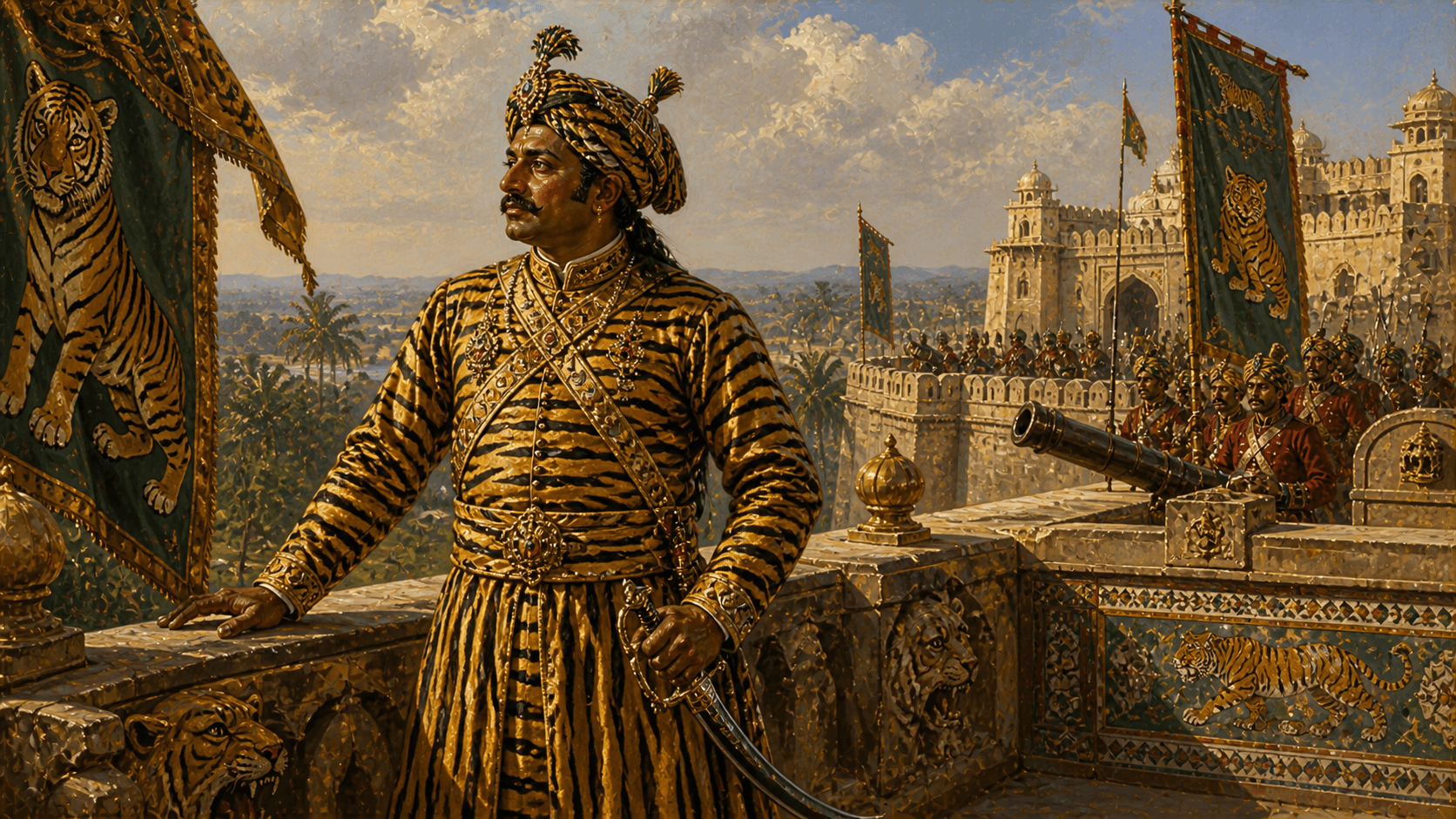
He reformed the administration of Mysore, introduced new coinage, established a calendar, and promoted trade, including a state trading company modelled on European examples. His palace at Srirangapatna (the island fortress of Seringapatam) was decorated with tiger motifs: tiger-striped soldiers, tiger heads on his throne, and the famous mechanical tiger automaton, a life-size wooden tiger mauling a British soldier, now displayed in the Victoria and Albert Museum in London.
He corresponded with Napoleon Bonaparte and the French Directory seeking military support against the British, and sent embassies to the Ottoman Empire and Afghanistan. These diplomatic efforts alarmed the Company and contributed directly to Richard Wellesley’s decision to attack Mysore before French aid could arrive.
The Anglo-Mysore Wars
- 1780-84
Second Anglo-Mysore War
Hyder Ali invaded the Carnatic and defeated a British force at Pollilur in 1780. Tippu succeeded his father in 1782 and continued the war, signing the Treaty of Mangalore in 1784 on terms favourable to Mysore.
- 1790-92
Third Anglo-Mysore War
Lord Cornwallis led a coalition of the Company, the Nizam of Hyderabad and the Marathas against Tippu. Defeated after a siege of Seringapatam, Tippu was forced to cede half his territory and surrender two of his sons as hostages.
- 1799
Fourth Anglo-Mysore War
Governor-General Richard Wellesley ordered the destruction of Mysore. General Harris invested Seringapatam. The fortress was stormed on 4 May 1799. Tippu Sultan was killed. The Kingdom of Mysore was dismembered.
The Siege of Seringapatam, 1799
Richard Wellesley, the Governor-General, decided to strike before French support could reach Tippu. General George Harris marched on Seringapatam with approximately 20,000 men, including Arthur Wellesley commanding a brigade. The fortress was invested in April 1799 and the walls breached over several weeks.
On 4 May the British stormed the breaches. The fighting inside the fortress was savage. Tippu Sultan was found dead near the northern gate, among his soldiers, weapon in hand. He had not surrendered. Whether he was killed by a musket ball during the fighting or murdered after capture is disputed by historians; contemporary British accounts state he died fighting.
Arthur Wellesley was appointed governor of the captured city. The Kingdom of Mysore was dismembered: a puppet Hindu maharaja was installed, and the Company absorbed the most valuable territories.
Read the full Seringapatam page →Legacy
Tippu Sultan has become a symbol of resistance to colonialism in India. His image has appeared on Indian postage stamps, streets and institutions are named after him, and he is celebrated in Karnataka as a regional hero. His rocket technology directly inspired William Congreve’s development of the British military rocket, which was used at Copenhagen, Leipzig and Waterloo. The mechanical tiger automaton, his most famous artefact, remains one of the most popular exhibits at the Victoria and Albert Museum.
His legacy is, however, deeply contested. Documented atrocities against Hindu and Christian populations in Coorg (Kodagu) and Malabar, including forced conversions, deportations and massacres, are recorded in both Indian and British sources of the period. Historians debate the scale and context: some argue these were acts of war and political consolidation comparable to those of other eighteenth-century rulers; others view them as systematic religious persecution.
An honest assessment recognises both Tippu’s courage and military innovation and the suffering inflicted under his rule. He was neither the uncomplicated hero of nationalist hagiography nor the monster of colonial propaganda. He was a formidable, ambitious, and at times ruthless ruler who fought harder against the Company than anyone before or after him.
In Sharpe’s World
Fiction · Bernard Cornwell
Cornwell portrays Tippu Sultan in Sharpe’s Tiger as a dangerous, intelligent ruler: theatrical, cruel to his enemies, and genuinely formidable. The novel’s depiction of the siege of Seringapatam, including the storming of the breach and Tippu’s death, follows the historical record closely. Cornwell fictionalises Sharpe’s mission inside the fortress and invents several of Tippu’s advisers, but the setting, the siege, and the ruler himself are drawn from documented sources.
Further Reading
The Anarchy
The definitive modern account of the East India Company’s rise. Dalrymple’s chapters on the Mysore wars and Tippu’s resistance are drawn from Indian, Persian and Company sources.
Buy on Amazon →As an Amazon Associate I earn from qualifying purchases.