
The Battle of Borodino
7 September 1812 · The Bloodiest Day of the Napoleonic Wars
Background
For two months the Russian army had retreated before Napoleon, refusing battle, drawing the Grande Armée deeper into Russia. At Borodino, seventy-five miles west of Moscow, Kutuzov finally decided to stand. He could not yield Moscow without a fight: the political pressure was too great, and his army, reinforced and rested, was as strong as it would ever be.
Napoleon needed a decisive victory. His army was weakened by disease, desertion and the long advance. He needed to destroy the Russian army in a single action and force Tsar Alexander to negotiate. Borodino was his opportunity.
The Armies
France
Under Napoleon. The Grande Armée, weakened by the advance but still formidable. The Imperial Guard held in reserve.
Russia
Under Prince Kutuzov. Entrenched behind earthwork fortifications: the Raevsky Redoubt and the Bagration Flèches.
The Battlefield
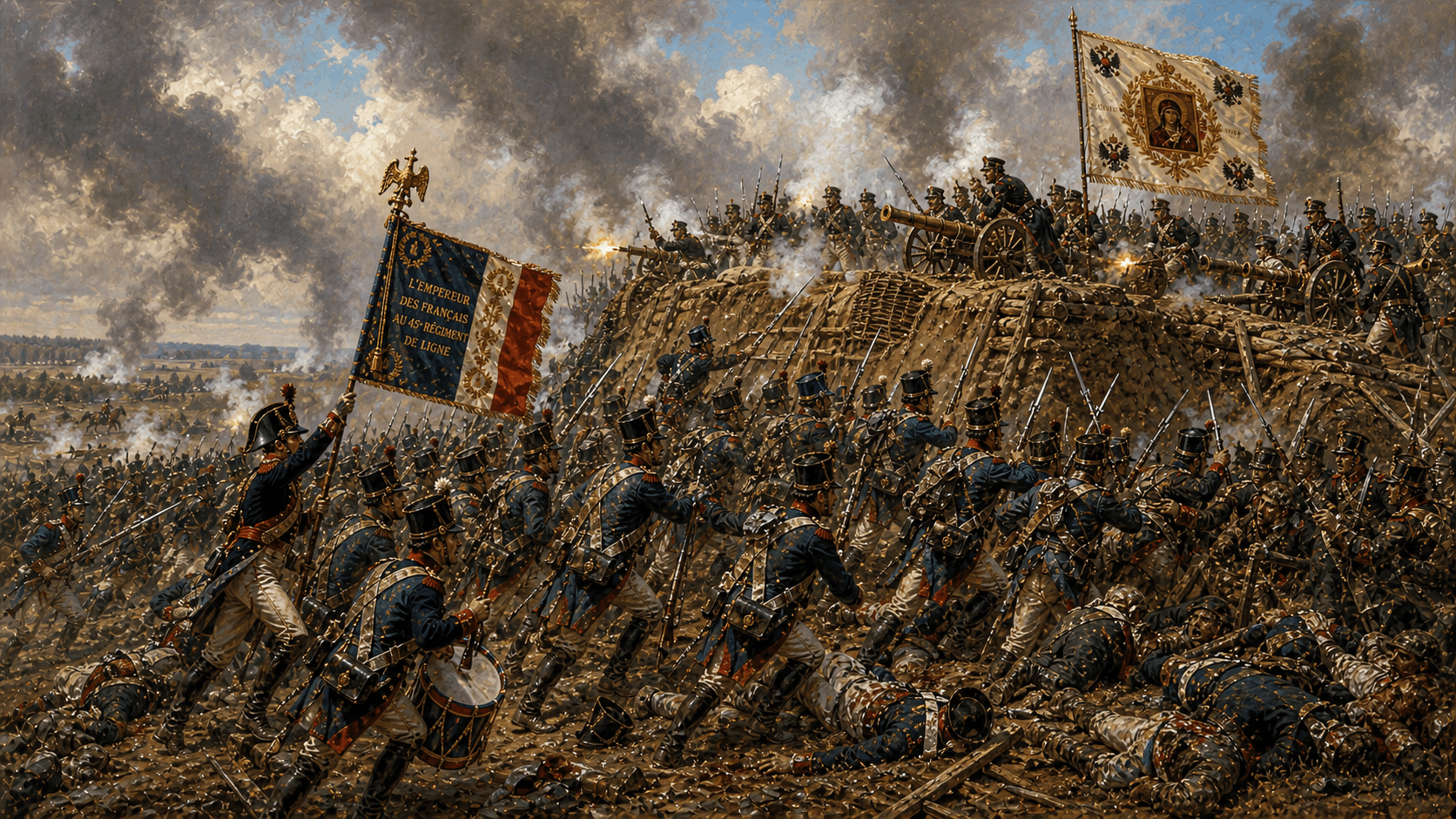
The Russian position was anchored on three key fortifications: the Raevsky Redoubt in the centre, a great earthwork fort bristling with artillery; the Bagration Flèches on the left, a series of arrow-shaped field works; and the village of Borodino on the right, covering the approach across the Kolocha river. Kutuzov had used the weeks of retreat to construct these positions and they would exact a terrible price.
The Battle
The battle was a series of brutal frontal assaults. Napoleon lacked the room for manoeuvre that had characterised his earlier victories. Instead he hammered the Russian positions with massed artillery and infantry attacks. The Bagration Flèches changed hands seven times. Prince Bagration himself was mortally wounded leading a counterattack.
The Raevsky Redoubt fell at last in the early afternoon when Eugène’s corps stormed it from the front while cavalry attacked from the flanks. The fighting inside the redoubt was hand to hand, among the dead piled on the gun platforms. When it fell, the Russian centre was broken, but Kutuzov simply pulled his line back a few hundred yards and reformed.
Napoleon’s Fatal Decision
At the crisis of the battle, with the Russian centre broken, Napoleon’s marshals begged him to commit the Imperial Guard for the final blow that would destroy Kutuzov’s army. Napoleon refused. According to the memoir of Philippe de Ségur, he said he would not have the Guard destroyed eight hundred leagues from France. The attribution is to Ségur’s account, which is not universally accepted as verbatim but is the primary source for this decision.
Without the Guard, the French could not exploit their advantage. Kutuzov withdrew in good order during the night. The Russian army survived to fight another day.
Casualties
Casualty figures are disputed between sources. The ranges given reflect the disagreement between French, Russian and modern historians.
Why It Mattered
Borodino opened the road to Moscow. But it did not destroy the Russian army, which was what Napoleon needed. A week later he entered Moscow to find it burning. Alexander refused to negotiate. Within eight weeks the retreat began, and the greatest military disaster in history followed.
The decision not to commit the Guard haunted Napoleon. At Waterloo three years later, the same question arose, and this time he committed them. They were broken by the 52nd and the Guards on the ridge of Mont-Saint-Jean.