
The Siege of Badajoz
April 1812 · The Bloodiest Night of the Peninsular War
Background
Badajoz was the gateway between Portugal and Spain. Whoever held the fortress controlled the main southern route of invasion. Wellington needed to take it before Marshal Soult could march from Andalusia to relieve the garrison. The siege had to be fast, which meant a storm rather than a methodical reduction. Everyone knew what that meant.
The Fortress
Badajoz was defended by a garrison of approximately 5,000 men under General Armand Philippon, one of the most capable French engineers. The fortress was protected by thick walls, a castle, inundations that flooded the approaches, and three breaches that Philippon had turned into killing grounds: lined with chevaux de frise (sword blades set in timber), broken glass, exploding shells on fuses, and planks studded with nails.
The Assault: 6 April 1812
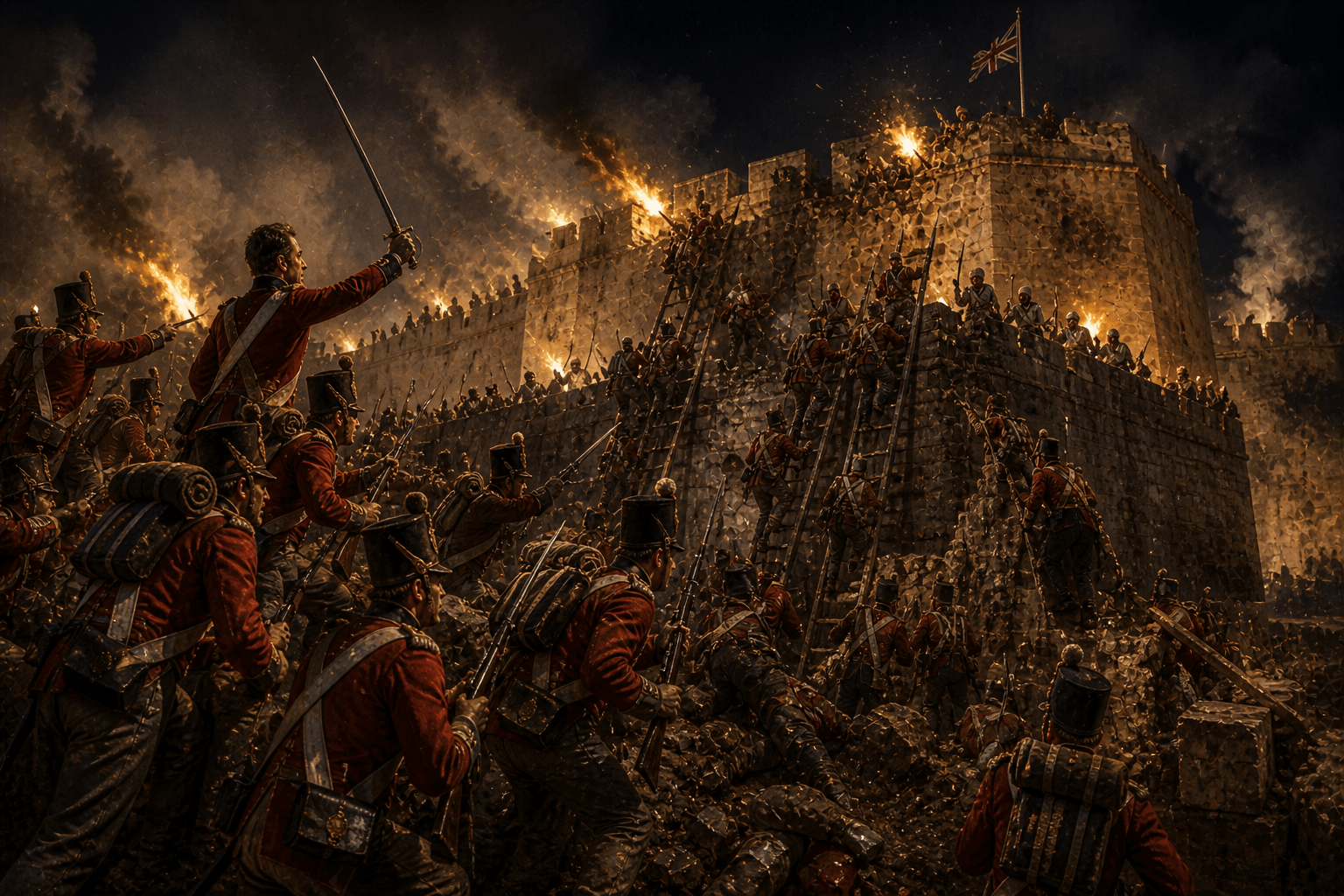
At 10pm on 6 April, three simultaneous attacks were launched. The Light Division and the 4th Division attacked the breaches in the walls. The 3rd Division under Picton escaladed the castle from the east. A Portuguese brigade attacked the San Vincente bastion from the west.
At the breaches, the slaughter was appalling. Wave after wave of soldiers climbed into the ditch and tried to force their way through the defences. Bodies piled in the breaches until men could climb on them. Forty separate assaults were thrown at the Trinidad breach alone. The defenders fired at point-blank range into the mass of attackers.
It was Picton’s 3rd Division, escalading the castle walls with ladders, that actually broke into the fortress while the breach assaults were failing. Once the castle was taken, the French defences unravelled. By dawn, Badajoz had fallen.
The Sack of Badajoz
What followed the storming was three days of uncontrolled looting, drunkenness and violence by British soldiers. The sack of Badajoz was one of the worst episodes of discipline breakdown in British military history. Soldiers who had endured the horror of the breaches turned their rage on the civilian population. Wellington ordered the provost marshal to restore order; it took three days and the erection of a gallows before discipline was re-established.
Casualties
Wellington wept on the glacis at dawn when he saw the carnage. It was one of the bloodiest nights in British military history.
The 95th Rifles at Badajoz
The 95th were part of the Light Division that attacked the breaches. They suffered catastrophic losses in the ditch and on the glacis. Riflemen who had survived years of skirmishing warfare were killed in minutes trying to force their way through the chevaux de frise. The regiment’s losses at Badajoz were among the worst it suffered in the entire war.
In Sharpe’s World
Sharpe’s Company is set at Badajoz. Hakeswill returns to plague Sharpe; Teresa Moreno is murdered during the sack. The storming of the breaches and the brutal aftermath form the climax of the novel and one of the darkest episodes in the entire series.
Sharpe’s Company →Why It Mattered
Badajoz opened the road into Spain. Within months Wellington had won Salamanca and entered Madrid. The cost was terrible, but the strategic result was decisive: France’s hold on southern Spain was broken.
As an Amazon Associate I earn from qualifying purchases.