
The Battle of Trafalgar
21 October 1805 · Cape Trafalgar, off south-west Spain
Background
By the autumn of 1805, Napoleon’s plan to invade Britain depended on gaining temporary control of the English Channel. His strategy required the Franco-Spanish fleet under Vice-Admiral Villeneuve to break out of the Mediterranean, draw the British fleet to the West Indies, double back across the Atlantic, and secure the Channel long enough for the Grande Armée to cross from Boulogne.
The plan had already failed. Villeneuve, after a confused cruise to the Caribbean and back, had retreated to Cadiz rather than risk a confrontation with the Royal Navy in the Channel. Napoleon abandoned the invasion and marched east towards Ulm and Austerlitz. But Villeneuve, under pressure from Paris and facing replacement, put to sea on 19 October 1805 with thirty-three ships of the line, heading for the Mediterranean. Nelson, with twenty-seven ships, was waiting.
The Fleets
Royal Navy
Under Vice-Admiral Horatio Nelson in HMS Victory. Collingwood commanded the lee column in Royal Sovereign. The fleet included no first-rates other than Victory herself, but every crew had been drilled to a pitch of gunnery that no other navy could match.
Franco-Spanish
Under Vice-Admiral Pierre-Charles Villeneuve. The fleet included the massive Spanish four-decker Santissima Trinidad, the largest warship afloat. Many crews were under-trained and undermanned; morale was low after months in harbour.
Nelson’s Plan
Nelson planned to break the enemy line in two places simultaneously, attacking at right angles with two columns of ships. His column, the weather column, would strike the enemy centre; Collingwood’s lee column would cut through the rear. This would isolate the Franco-Spanish van, which would have to reverse course against the wind to rejoin the battle, taking hours to return.
The approach would be dangerous: the leading ships in each column would be under fire for thirty minutes or more before they could bring their own guns to bear. Nelson accepted the risk because he knew his crews could fire two or three broadsides to every one from the enemy. Once alongside, the superior British gunnery would be decisive.
Before the battle, Nelson signalled the famous message: “England expects that every man will do his duty.”
The Battle
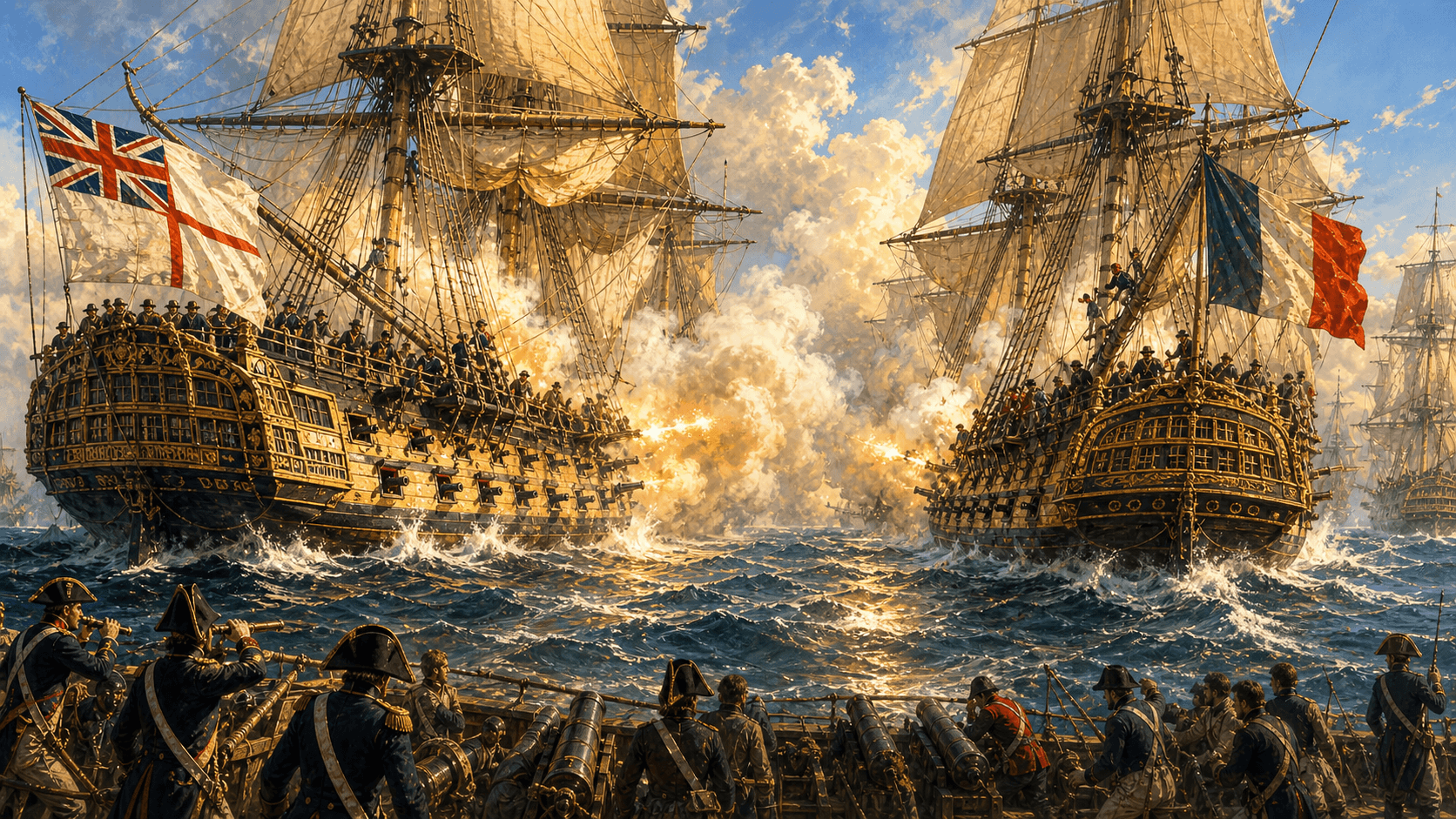
The two British columns approached the Franco-Spanish line in light winds, under a long, slow cannonade. Collingwood’s Royal Sovereign broke through the enemy rear first, at approximately noon, engaging the Santa Ana at point-blank range. Nelson’s Victory cut the line at approximately 12:30, passing under the stern of Villeneuve’s flagship Bucentaure and raking her with a devastating broadside.
What followed was a brutal close-range mêlée. Ships fought yardarm to yardarm, their rigging tangled, their gun crews firing into each other’s hulls at a distance of feet. The French ship Redoutable, lashed alongside Victory, sent her crew to board, and the fighting became hand to hand on Victory’s deck. It was a sharpshooter in the Redoutable’s mizzen top who fired the shot that struck Nelson.
The Franco-Spanish van, exactly as Nelson had planned, was unable to return in time. By late afternoon, nineteen enemy ships had been taken or destroyed. Not a single British ship was lost.
The Death of Nelson
Nelson was struck at approximately 1:15 in the afternoon by a musket ball fired from the mizzen top of the Redoutable. The ball entered his left shoulder, passed through his spine, and lodged below his right shoulder blade. He was carried below to the cockpit of Victory by Sergeant Secker of the Royal Marines and two sailors.
Dr William Beatty, the ship’s surgeon, attended him. Nelson was conscious and in great pain. He asked repeatedly how the battle was going. Captain Hardy visited him twice: on the second visit he informed Nelson that fourteen or fifteen enemy ships had struck their colours. Nelson replied: “That is well, but I bargained for twenty.”
His last recorded words, repeated several times, were: “Thank God, I have done my duty.” He died at approximately 4:30 in the afternoon, knowing the battle was won. His body was preserved in a cask of brandy for the voyage home.
Casualties
449 killed, approximately 1,250 wounded. Not one British ship lost.
Approximately 4,400 killed, 2,500 wounded, 7,000 captured. 19 ships taken or destroyed.
Why It Mattered
Trafalgar ended any realistic prospect of a French invasion of Britain. The Royal Navy’s supremacy at sea was established beyond challenge for the next century. Napoleon could dominate Europe by land, but he could never cross the Channel.
The strategic consequences were immense. British command of the sea allowed the Peninsular War to be sustained by supply from the ocean. It protected British trade, funded the coalitions against France, and ensured that the war would ultimately be decided on land where Napoleon could be worn down by the relentless pressure of enemies he could defeat but never destroy.
In Sharpe’s World
Fiction · Bernard Cornwell
Sharpe’s Trafalgar places Sharpe aboard an East Indiaman during the battle. Having survived India, Sharpe is sailing home when he finds himself caught up in the greatest naval engagement ever fought. Cornwell uses the battle to show the war at sea through a soldier’s eyes.
Buy Sharpe’s Trafalgar →Visit Today
HMS Victory
Nelson’s flagship, preserved in dry dock at the Portsmouth Historic Dockyard. You can walk the quarterdeck where Nelson fell and visit the cockpit where he died.
National Maritime Museum
Greenwich, London. Houses Nelson’s uniform coat with the hole made by the fatal musket ball, along with the most comprehensive collection of Trafalgar artefacts in the world.
Trafalgar Cemetery
Gibraltar. The burial place of sailors who died of wounds after the battle. The cemetery is a short walk from the harbour where damaged British ships put in for repair.
As an Amazon Associate I earn from qualifying purchases.