
The Peninsular War (1807-1814)
Wellington’s Iberian Campaign Against Napoleon
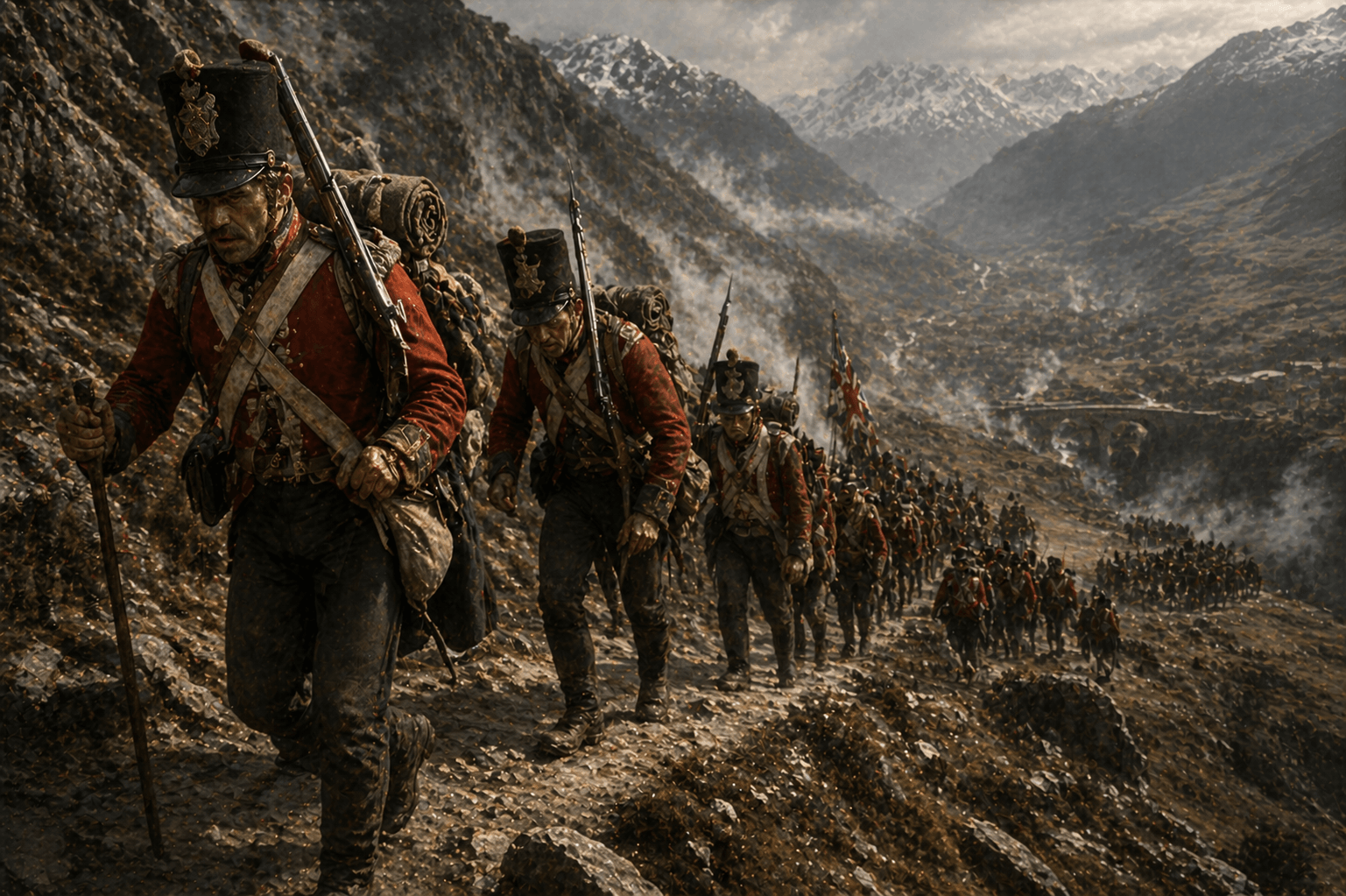
The Peninsular War (1807-1814) was fought across Portugal, Spain, and southern France between Napoleon’s forces and a coalition led by Britain under Sir Arthur Wellesley (later the Duke of Wellington), together with Portuguese and Spanish armies and irregular Spanish guerrillas. It was not one long march but a series of campaigns, sieges, and battles that gradually shifted the balance from French domination of Iberia to the invasion of southern France. Wellington rarely sought battle unless the conditions favoured him. Instead, he fought a war of logistics, manoeuvre, and attrition, using Portugal as a secure base while Spain’s guerrillas bled French communications.
Below is a chronological overview of the major engagements, from the first British landings in Portugal through to Wellington’s crossing of the Pyrenees and the final battle at Toulouse.
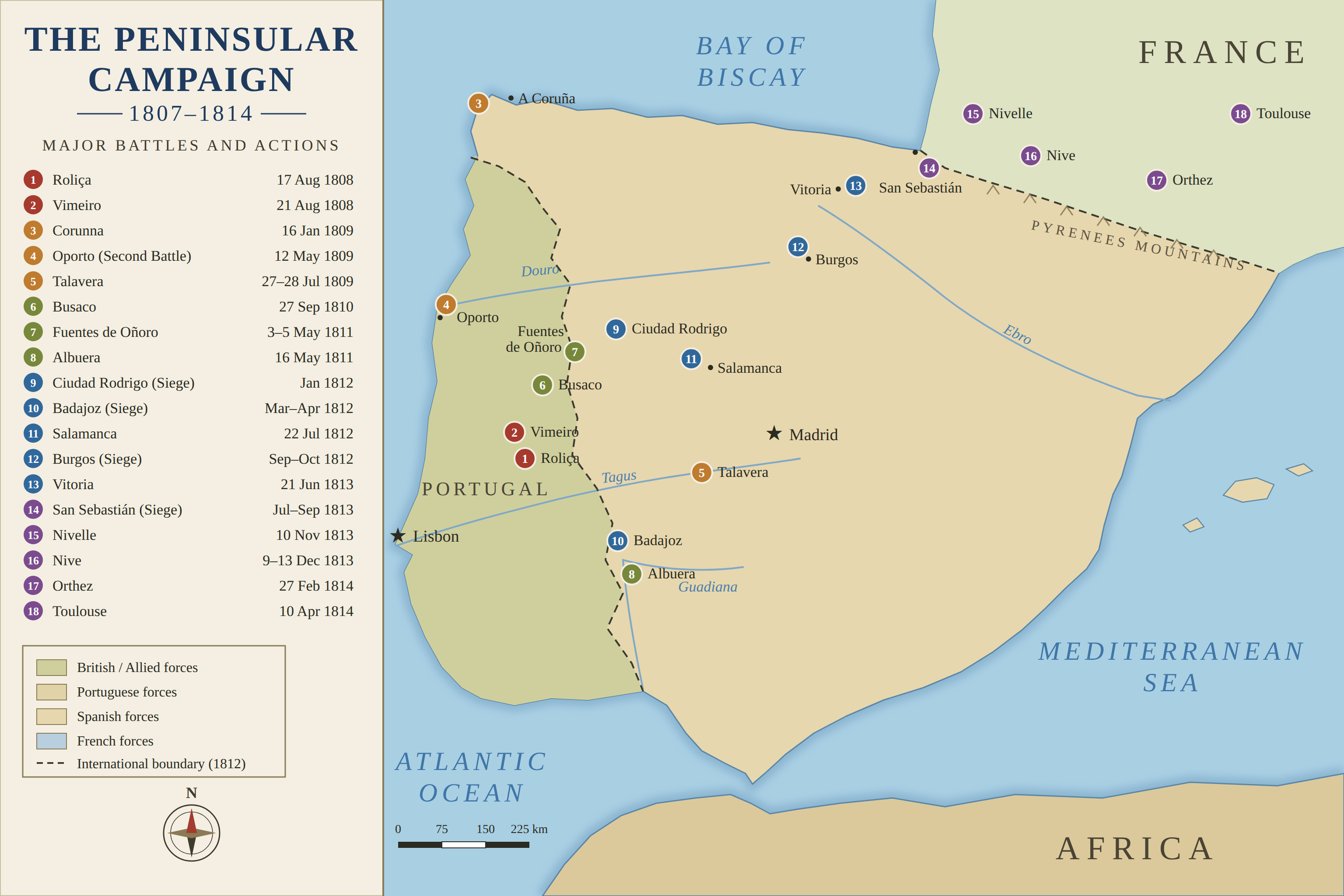
The Peninsular Campaign 1807-1814
The Battles in Chronological Order
Rolica
The Peninsular War truly began for Britain when Sir Arthur Wellesley landed in Portugal during the summer of 1808. Junot had occupied Portugal the previous year, but Spain had erupted in revolt following Napoleon's seizure of the Spanish throne. Britain recognised an opportunity. French General Delaborde was ordered to delay the British advance long enough for Junot to concentrate his scattered forces.
Although tactically minor, Rolica marked the first major British victory against Napoleon's veteran armies in the Peninsula.
Vimeiro
Junot realised he had to defeat Wellesley before more British reinforcements arrived. He attacked aggressively near the village of Vimeiro.
Junot's defeat effectively ended French control of Portugal for the time being.
Corunna
Napoleon personally entered Spain late in 1808 with over 200,000 troops. Sir John Moore advanced into northern Spain hoping to threaten French communications but suddenly found Napoleon marching directly against him. Moore conducted one of history's greatest fighting retreats across snow-covered mountains before reaching Corunna.
The battle was technically a British victory because the evacuation succeeded.
Second Battle of Oporto
Marshal Soult invaded Portugal for a second time. Wellesley returned to command British forces.
Portugal was liberated for the second time.
Talavera
Wellington advanced into Spain alongside the Spanish army under General Cuesta. Relations between the allies were poor from the outset.
Talavera earned Wellesley his Viscount Wellington title.
Busaco
Marshal Masséna's third French invasion of Portugal advanced into the interior. Wellington chose the long ridge at Busaco as a defensive position, hoping to bloody the French before withdrawing behind the Lines of Torres Vedras.
Busaco delayed Masséna's advance and demonstrated the growing skill of Wellington's Portuguese troops fighting alongside British regiments.
Fuentes de Onoro
Marshal Masséna, having finally retreated from the Lines of Torres Vedras, attempted to relieve the besieged fortress of Almeida.
Masséna ultimately failed to relieve Almeida.
Albuera
Marshal Soult attempted to relieve the French garrison at Badajoz. The Allied army was commanded by Marshal Beresford in Wellington's absence.
The battle was tactically inconclusive but strategically prevented Soult from relieving Badajoz.
Siege of Ciudad Rodrigo
The great fortress of Ciudad Rodrigo guarded the northern invasion route from Portugal into Spain. Without it, Wellington could not safely invade.
The siege lasted only twelve days.
Siege of Badajoz
If Ciudad Rodrigo guarded the northern road, Badajoz controlled the southern crossing of the Portuguese frontier. A first British attempt to take the fortress in 1811 had failed. Leaving it in French hands remained impossible.
Badajoz secured Wellington's communications permanently.
Salamanca
Marshal Marmont attempted to outflank Wellington near Salamanca. His army became dangerously overextended along the line of march.
Salamanca was Wellington's masterpiece of battlefield command.
Siege of Burgos
Seeking to consolidate his advance after Salamanca, Wellington attempted to capture Burgos Castle.
Wellington abandoned the siege and conducted another masterful retreat back to Portugal.
Vitoria
Joseph Bonaparte, Napoleon's brother and installed King of Spain, attempted to withdraw from Spain carrying vast quantities of treasure and supplies.
Vitoria effectively destroyed French rule in Spain.
Siege of San Sebastian
The coastal fortress of San Sebastian remained in French hands despite the disaster at Vitoria.
The fortress secured Allied supply lines along the northern coast and opened the way into the Pyrenees.
Nivelle
The Allies crossed onto French soil for the first time. Marshal Soult had constructed extensive defensive works along the Nivelle river.
For the first time, Wellington defeated the French on French soil.
Nive
Flooded rivers divided Wellington's army. Soult attempted to destroy isolated Allied corps.
Despite repeated French attacks, Soult failed to regain the initiative.
Orthez
Soult attempted another defensive stand while retreating toward Toulouse.
The road into southern France lay open.
Toulouse
Napoleon had already abdicated on 6 April, but news had not reached the armies in the south.
Often regarded as the final major battle of the Peninsular War, Toulouse remains controversial because it was fought after the war had effectively ended.
The Campaign in Perspective
Looking across these engagements, a clear pattern emerges. The early years were characterised by Britain’s struggle simply to survive in Portugal. The middle years focused on methodical siege warfare, with Ciudad Rodrigo and Badajoz opening the gateways into Spain. Salamanca demonstrated Wellington’s ability to seize fleeting tactical opportunities, while the failed siege of Burgos showed the limits of his resources. Finally, Vitoria transformed the war from one of liberation into one of invasion, carrying the Allied armies across the Pyrenees and into France itself.
Unlike Napoleon’s preference for seeking decisive annihilation in a single campaign, Wellington won through patience, logistics, discipline, and careful management of risk. The Peninsular War became one of the greatest examples of coalition warfare in European history, steadily eroding French strength until the Allies stood on French soil, helping to set the stage for Napoleon’s first abdication in 1814.
Explore More
The retreat that became a legend and the death of Sir John Moore.
Wellington's masterpiece of battlefield command.
The bloodiest siege of the war.
The commander who never lost a major battle.
The green-jacketed riflemen whose service ran throughout the Peninsula.
Hanover's exiles in British service.
Bernard Cornwell's novels, set during the Peninsular War.
Further Reading
As an Amazon Associate I earn from qualifying purchases.
Page last updated: July 2026