
The Siege of Ciudad Rodrigo
8 to 19 January 1812 · Wellington’s Race Against Time
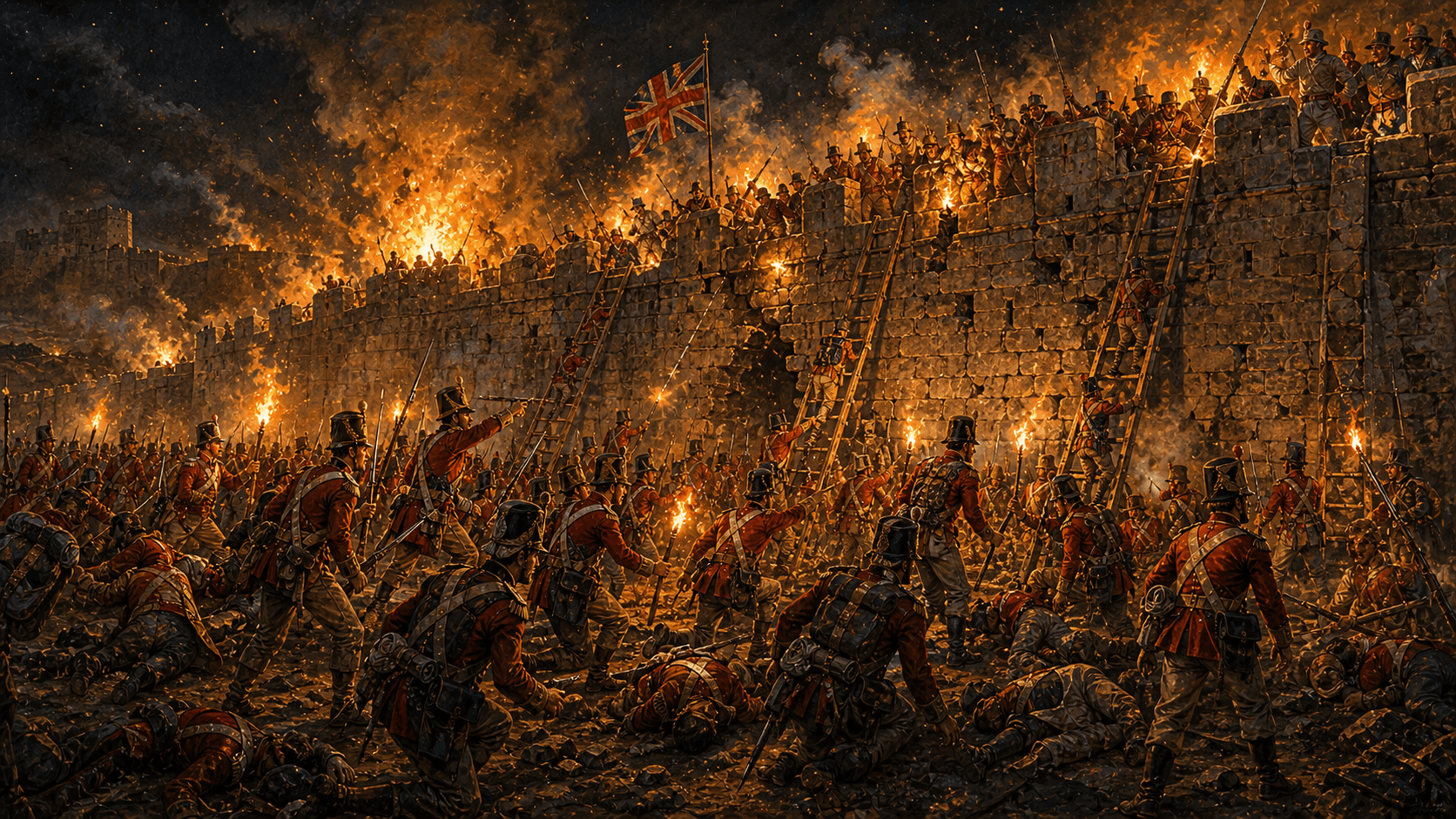
The Siege of Ciudad Rodrigo, 8 to 19 January 1812, was one of the most important operations of the Peninsular War. An Anglo-Portuguese army commanded by Arthur Wellesley, Viscount Wellington, besieged and stormed the French-held Spanish fortress of Ciudad Rodrigo, close to the Portuguese frontier.
The operation lasted only eleven days. Wellington’s particular achievement was speed: rather than conducting a prolonged formal siege, he captured Ciudad Rodrigo before Marshal Marmont could concentrate a French relief army.
The fortress was stormed on the evening of 19 January 1812. Two general officers, Major-General Henry MacKinnon and Major-General Robert Craufurd, were among those killed or mortally wounded during the assault. The capture was followed by the sack of the town by Allied soldiers, despite Spain being Britain’s ally.
Ciudad Rodrigo was followed by the considerably bloodier Siege of Badajoz in April 1812. Together the two frontier fortresses opened the way for Wellington’s offensive campaign in Spain, culminating in his victory at Salamanca on 22 July 1812.
Strategic Background
Ciudad Rodrigo lies in western Spain near the Portuguese border and the River Águeda. Its strategic importance came from its position controlling the northern invasion route between Portugal and central Spain. The fortress had been captured by the French from its Spanish defenders in 1810.
By the beginning of 1812, the strategic situation in the Peninsula had begun to favour Wellington. French resources were increasingly stretched and Napoleon was preparing for the invasion of Russia. Wellington recognised an opportunity to move from the largely defensive struggle for Portugal towards offensive operations inside Spain.
Two major fortresses obstructed this strategy: Ciudad Rodrigo, guarding the northern route, and Badajoz, guarding the southern route. Wellington decided to capture both.
Time was crucial. A conventional lengthy siege risked allowing a French field army to concentrate and force Wellington to abandon the operation. Ciudad Rodrigo therefore became as much a race against French relief forces as a siege against the garrison itself.
The French Garrison
Ciudad Rodrigo was commanded by Brigadier-General Jean Léonard Barrié. The French garrison numbered approximately 1,800 to 2,000 men, drawn from the Army of the North under General Dorsenne. Although relatively small, the defenders possessed fortified walls, artillery and prepared defensive positions.
The town itself was not a first-class fortress. It was built on top of a low hill overlooking the Águeda, surrounded by a thick medieval wall and a more modern line of low-lying fortifications. Since capturing the town in 1810, the French had improved the defences by building a fort on the summit of the Greater Tesón, the hill where they had placed their main artillery batteries during their own siege, and by strengthening the outlying suburb of San Francisco.
The French expected the fortress to delay Wellington long enough for Marshal Auguste Marmont to assemble a relief force. Wellington intended to ensure that this did not happen.
Opening of the Siege: 8 January 1812
Wellington began operations against Ciudad Rodrigo on 8 January 1812. The siege was conducted during extremely cold winter weather. Contemporary accounts mention frost and snow.
One of the immediate problems was an important French advanced position associated with the Greater Tesón, which overlooked ground required for the Allied siege works. On the opening night, a party from the Light Division, commanded by Major John Colborne of the 52nd Foot and comprising companies of the 43rd, 52nd and 95th together with the 1st and 3rd Portuguese Caçadores, attacked and captured the French position at the redoubt of San Francisco. This allowed the Allies to begin constructing batteries and approaches much closer to the fortress.
Building the Siege Works
British and Portuguese troops began constructing trenches, batteries and other siege works. The ground around Ciudad Rodrigo was rocky and in places difficult to excavate. Because digging conventional protection was hard, soldiers carried gabions, large wicker baskets filled with earth, forward to provide cover.
The work was extremely dangerous. French artillery knew where the working parties were operating and fired into them, including with grapeshot. Casualties among engineers and working parties occurred throughout the siege, days before the assault itself.
The Bombardment and the Breaches
Allied heavy artillery opened a sustained bombardment. The primary purpose was not simply to inflict casualties on the French garrison. The siege artillery needed to create practicable breaches in the fortress walls through which infantry could assault.
By 19 January, two important breaches had been created: the Great Breach and the Lesser Breach. Wellington decided they were sufficiently practicable to justify an immediate assault. Waiting longer might have improved the breaches but would also have given Marmont more time to concentrate a relief army. Wellington chose speed.
The Decision to Storm
The assault was ordered for the evening of 19 January 1812. The two principal attacks were assigned to:
- Major-General Thomas Picton’s 3rd Division to attack the Great Breach on the northwest of the fortress.
- Major-General Robert Craufurd’s Light Division to attack the Lesser Breach on the north.
Additional attacks were made elsewhere around the fortress, including important operations involving Portuguese troops. In total, Wellington deployed approximately 10,700 men in the various assaulting and supporting formations, although only a small fraction of these constituted the actual Forlorn Hopes.
What Was a Forlorn Hope?
The Forlorn Hope was a small body of volunteers placed at the very front of an assault against a fortified position. The term comes from the Dutch verloren hoop, meaning “lost troop”. It should not be confused with the entire storming party or assault column.
A simplified sequence was: Forlorn Hope, then storming party, then main assault column. The Forlorn Hope went first. Its tasks could include entering the breach before the main body, identifying or overcoming obstacles, absorbing the defenders’ first fire, establishing a foothold, clearing or identifying mines and obstructions, and creating enough space for the storming party behind.
The name reflects the extreme danger of the role, but the men were volunteers, not soldiers selected for a suicide mission. In British service, command commonly fell to an ambitious junior commissioned officer, particularly a lieutenant, though there was no formal regulation requiring a specific rank.
For an officer, successfully leading a Forlorn Hope offered an exceptional opportunity for distinction. Promotion, favourable attention from senior commanders and increased seniority could all follow. For an ambitious lieutenant whose normal promotion prospects might otherwise be slow, a successful storm could transform his career.
The 52nd Foot valued the honour of the Forlorn Hope so highly that in 1820 the regiment instituted its own Forlorn Hope Medal, awarded to survivors of the regimental Forlorn Hope parties at Ciudad Rodrigo, Badajoz and San Sebastián. The 52nd is believed to be the only regiment to have created such a medal.
The Great Breach: Picton’s 3rd Division
The 3rd Division attacked the Great Breach. The French had concentrated significant defensive measures there, including two guns embedded in the wall that swept the breach with grape and canister at close range.
Allied soldiers had to climb across shattered masonry under direct fire. When attackers reached the upper portion of the breach they encountered an additional problem: the ground inside was significantly lower than the exterior, creating a substantial drop beyond the ruined wall.
At the height of the attack, a French mine or magazine exploded among the attackers. The resulting explosion caused severe casualties and disorder. Major-General Henry MacKinnon, commanding a brigade of Picton’s 3rd Division, was killed. The two French guns were eventually silenced by men of the 88th (Connaught Rangers) and 45th, who captured one gun each.
Once the defensive positions above the breach were overcome, the Great Breach ceased to be tenable for the French.
The Lesser Breach: Craufurd’s Light Division
The Light Division attacked the Lesser Breach. The division included famous Peninsular formations: the 43rd Foot, the 52nd Foot and the 95th Rifles.
The Forlorn Hope at the Lesser Breach was led by Lieutenant John Gurwood of the 52nd Foot. He was severely wounded in the head during the assault but continued into the fortress after regaining consciousness. Making his way to the citadel, Gurwood took Governor Barrié prisoner. The governor surrendered his sword to Gurwood, who presented it to Wellington. Wellington subsequently returned it as a reward for Gurwood’s conduct.
Gurwood’s story has become one of the most famous individual episodes of the siege. He would later serve as editor of Wellington’s Dispatches.
Immediately behind the Forlorn Hope came the main storming party, 300 men under Major George Napier of the 52nd. The breach was carried at high cost.
Once Allied troops gained the ramparts, they could move along the fortifications and attack French positions from unexpected directions. The French defensive system began to unravel rapidly as defenders were attacked from behind as well as from the breaches.
The Death of Robert Craufurd
Robert Craufurd remained close to his troops during the assault. He was struck by a musket ball during the fighting. The wound passed through or near his arm and into his torso. Craufurd was carried from the battlefield and survived for several days. Wellington visited him while he was dying.
Craufurd died on 24 January 1812. He was buried close to the Lesser Breach, the position stormed by his Light Division.
His death was a major loss to the division whose reputation had become closely associated with him. Two of the Light Division’s brigade commanders, John Colborne of the 52nd and George Napier, were also wounded during the operation, as was General Vandeleur.
The Portuguese at Ciudad Rodrigo
Ciudad Rodrigo was not simply a British operation. Wellington commanded an Anglo-Portuguese army, and Portuguese soldiers contributed throughout the siege and participated directly in the assault.
Denis Pack’s Portuguese brigade attacked towards the Santiago Gate (some sources describe this position as the San Pelayo Gate). Their action captured an advanced defensive work and forced the French to defend that sector rather than concentrate every available man against the main breaches. Describing this attack as a “diversion” understates what happened.
Another Portuguese force under O’Toole crossed the Águeda and attacked from the southern direction. O’Toole’s men succeeded in penetrating the defences and entering the town. The collapse of the French position was therefore not simply the result of British troops forcing the two main breaches; French defenders increasingly faced Allied troops penetrating from several directions at once.
Portuguese Caçadores were also involved in the opening capture of the San Francisco redoubt on 9 January, alongside British light infantry.
The Fall of the Fortress
Once the Light Division penetrated the Lesser Breach and other Allied attacks succeeded elsewhere, the French position deteriorated quickly. Portuguese troops were also penetrating from other sectors. The French garrison withdrew towards the interior. Governor Barrié eventually surrendered.
The speed of the collapse after the breaches were penetrated contrasts sharply with the violence required to get through them. Once ramparts could be moved along, the defenders’ concentration on the breaches worked against them.
The Sack of the Town
The capture was followed by one of the darker episodes of the operation. Ciudad Rodrigo was a Spanish town. Spain was Britain’s ally. Nevertheless, discipline among parts of the victorious Allied force broke down after the storm.
Soldiers looted houses and businesses. In one French store, vats of rum were broken open and consumed; some soldiers are reported to have been pushed into the vats in the crush and drowned. Property was stolen or destroyed. Officers struggled to restore order.
The behaviour reflected a wider and brutal culture surrounding early nineteenth-century siege warfare. A military convention held that a fortress which refused to surrender after a practicable breach had been created and was subsequently taken by storm might be subjected to pillage. This is historical context, not justification.
Ciudad Rodrigo had just witnessed extraordinarily violent close-quarter fighting. Soldiers had watched friends killed in the breaches, many believed they had earned the right to plunder, large quantities of alcohol became available, and command structures temporarily broke down. The sack of Ciudad Rodrigo was overshadowed by the considerably worse breakdown of discipline that followed the storming of Badajoz three months later, but its contradiction remained acute: Wellington’s army had liberated a Spanish city from French occupation and then proceeded to plunder the inhabitants it had ostensibly come to assist.
George Simmons of the 95th Rifles described the appearance of soldiers leaving Ciudad Rodrigo after the storm. He wrote in his journal that the soldiers “were laden with all sorts of things, and looked like a moving rag-fair.”
John Kincaid, also of the 95th Rifles, wrote critically about the behaviour of victorious troops, observing that they “no sooner obtain possession, than they think themselves at liberty to do what they please, without considering that the poor inhabitants may nevertheless be friends and allies.” Kincaid’s testimony is particularly useful because it shows that some contemporary observers themselves recognised the moral contradiction.
Major Jonathan Leach, also of the 95th Rifles, wrote in his own memoir that “when a town is stormed, it is inevitable that excesses will be, as they have ever been, committed by assailants, more particularly if it takes place at night.”
Marmont’s Failed Relief
The strategic brilliance of the operation becomes clearest when viewed from the French perspective. Marshal Marmont expected Ciudad Rodrigo to resist long enough for him to concentrate a substantial field army. He began assembling forces to relieve the fortress. Wellington captured it before Marmont could intervene.
Accounts describe French forces subsequently advancing sufficiently far to confirm that the reports of Ciudad Rodrigo’s fall were true, before withdrawing. Wellington had achieved his principal operational objective: capture the fortress before a French field army could force him to abandon the siege.
This is why the eleven-day timescale matters. Ciudad Rodrigo was not simply a successful siege. It was a successful race against French concentration.
Casualties
Casualty figures for sieges of this period vary between sources and should be treated as approximate rather than definitive.
Wellington’s Rewards
The capture considerably enhanced Wellington’s reputation. Following Ciudad Rodrigo, he was advanced in the British peerage as Earl of Wellington. The Spanish also awarded him the title Duque de Ciudad Rodrigo.
The victory demonstrated that Wellington’s army was capable not merely of defending Portugal or defeating French armies in conventional battles, but of conducting aggressive siege warfare against important fortified positions.
What Happened Next
Ciudad Rodrigo solved only half of Wellington’s strategic problem. The northern gateway into Spain was now substantially more secure. The southern fortress of Badajoz remained in French hands.
Wellington therefore moved south against Badajoz. It was stormed on 6 April 1812. Badajoz proved much more costly than Ciudad Rodrigo; the assault and subsequent sack became some of the most notorious episodes in the history of Wellington’s army.
With both frontier fortresses captured, Wellington possessed much greater freedom to operate inside Spain. This helped create the strategic circumstances leading to the Battle of Salamanca on 22 July 1812, where Wellington defeated Marmont and subsequently entered Madrid.
Ciudad Rodrigo therefore belongs to the wider transformation of the Peninsular War during 1812, when Wellington moved from defending Portugal to carrying the war deep into French-held Spain.
Read the Eyewitness Accounts
Two 95th Rifles officers whose memoirs describe Ciudad Rodrigo in detail are essential reading for anyone who wants to move from summary to primary source.
Adventures in the Rifle Brigade
The witty, literate voice of the Light Division. Kincaid served with the 95th from Walcheren through the Peninsula to Waterloo. His account of Ciudad Rodrigo is one of the best short descriptions of the siege from an officer who was there.
A British Rifle Man: The Journals and Correspondence of Major George Simmons
Detailed contemporary journals and correspondence from a rifleman who served throughout the Peninsular War and was wounded at Waterloo. His account of the sack of Ciudad Rodrigo, with the soldiers looking like “a moving rag-fair”, is one of the most vivid passages in Peninsular literature.
For the broader campaign context, Charles Esdaile’s The Peninsular War: A New History (2002) and Rory Muir’s Wellington: The Path to Victory 1769-1814 (2013) are the modern standard works. Both are covered on our full reading list of Napoleonic Wars books →
Frequently Asked Questions
When was the Siege of Ciudad Rodrigo?
The siege lasted from 8 to 19 January 1812. Wellington's Anglo-Portuguese army stormed the fortress on the evening of 19 January.
Why was Ciudad Rodrigo important?
Ciudad Rodrigo controlled the northern road between Portugal and Spain. Together with Badajoz, which guarded the southern route, it was one of the two major fortress obstacles preventing Wellington from moving his army safely from Portugal into Spain for an offensive campaign.
How long did the Siege of Ciudad Rodrigo last?
Eleven days. Wellington deliberately conducted the operation at speed to prevent Marshal Marmont from concentrating a French relief army.
Who commanded the French garrison at Ciudad Rodrigo?
Brigadier-General Jean Léonard Barrié. The garrison numbered approximately 1,800 to 2,000 men.
What was a Forlorn Hope?
A small body of volunteers placed at the very front of an assault against a fortified position. The name comes from the Dutch verloren hoop, or 'lost troop'. Its role was to enter the breach first, absorb the defenders' initial fire, and clear the way for the main storming party. It was extremely dangerous, but successful volunteers could expect promotion or other rewards, so competition for places could be intense.
Who was John Gurwood?
Lieutenant John Gurwood of the 52nd Foot led the Forlorn Hope at the Lesser Breach of Ciudad Rodrigo. He was severely wounded in the head but continued into the fortress, took the French governor Barrié prisoner, and received Barrié's sword from Wellington as a reward. Gurwood later served as editor of Wellington's published Dispatches.
How did Robert Craufurd die?
Major-General Robert Craufurd, commander of the Light Division, was struck by a musket ball during the assault on 19 January 1812. He was carried from the battlefield and died several days later on 24 January. He was buried close to the Lesser Breach, the position stormed by his own division.
How many soldiers were killed at Ciudad Rodrigo?
Allied casualties during the siege are commonly given at approximately 195 killed and 916 wounded. French casualties were approximately 529 killed or wounded. Most of the surviving French garrison became prisoners.
Did the British really loot Ciudad Rodrigo?
Yes. After the successful storm, discipline broke down and Allied soldiers looted the town for one night. This happened despite Ciudad Rodrigo being a Spanish city and Spain being Britain's ally. The sack of Ciudad Rodrigo was overshadowed by the considerably worse sack of Badajoz three months later.
What Sharpe book is set at Ciudad Rodrigo?
Sharpe's Company (1982), the thirteenth novel in chronological order of the Sharpe series, is set during the sieges of Ciudad Rodrigo and Badajoz in early 1812.
Explore More
The complete campaign guide, from Rolica in 1808 to Toulouse in 1814.
The bloodier sister siege, stormed on 6 April 1812. Notorious for its aftermath.
Wellington's masterpiece, 22 July 1812. Forty thousand men beaten in forty minutes.
The commander who never lost a major battle. Made Earl for Ciudad Rodrigo.
The green jackets of the Light Division, at the Lesser Breach.
The complete author guide across every series.
All 24 Sharpe novels in reading order, including Sharpe's Company.
Curated non-fiction on the Peninsular War, Wellington and Napoleon.
As an Amazon Associate I earn from qualifying purchases.
Page last updated: September 2026