
Wellington in India
1797–1805 · The Campaigns That Made Him
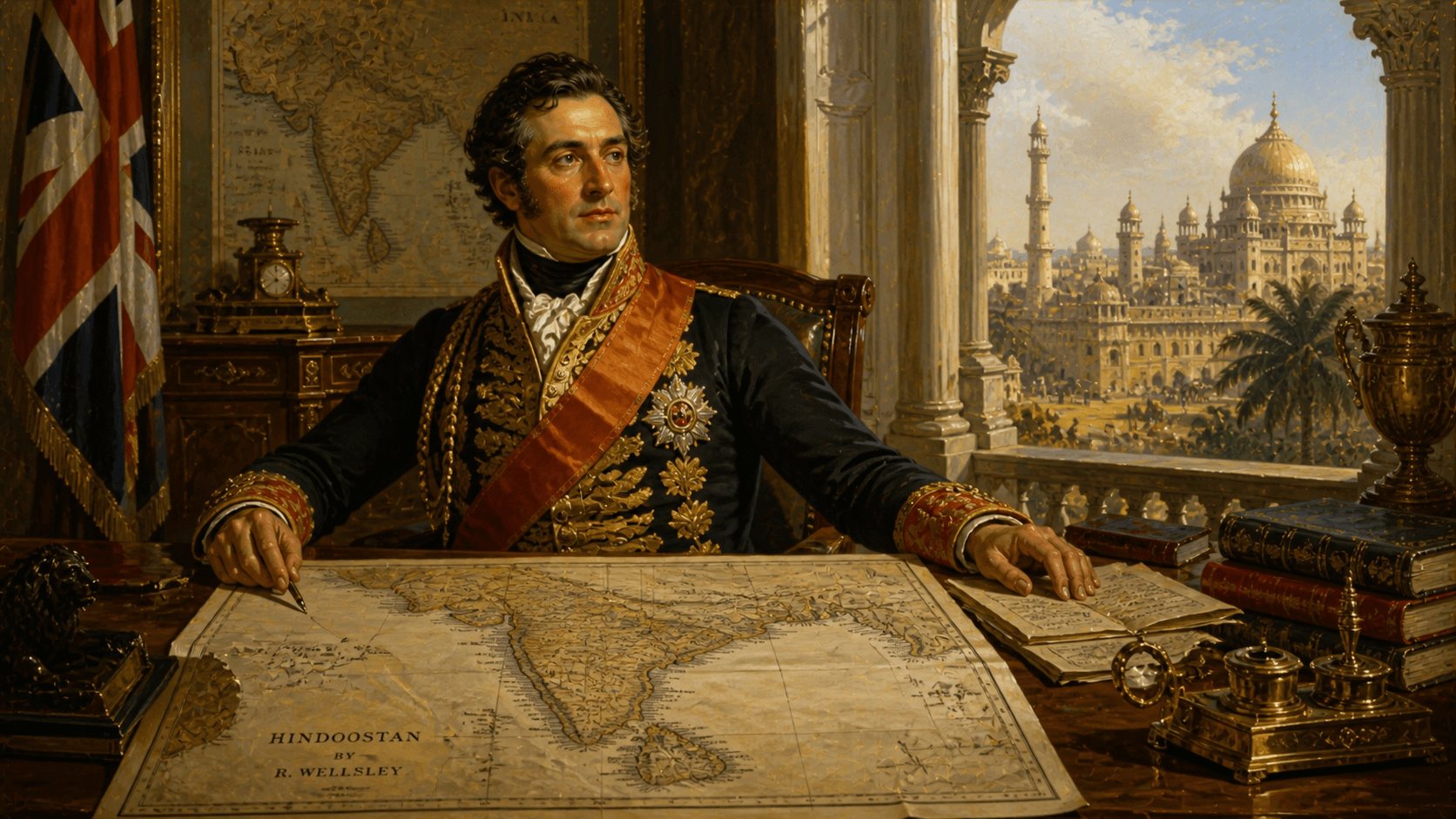
Arrival in India
Arthur Wellesley arrived in India in February 1797, aged twenty-seven, as colonel of the 33rd Regiment of Foot. His elder brother Richard had been appointed Governor-General, a coincidence of patronage that gave Arthur opportunities few junior officers could expect. India in the late eighteenth century was a theatre of constant warfare between the Company, the Indian powers, and French influence. For an ambitious soldier with connections, it was the making ground.
The brothers Wellesley worked in tandem: Richard provided the political authority and strategic direction, Arthur provided the military execution. It was an arrangement that would deliver British supremacy across southern India within eight years.
Seringapatam 1799
The Fourth Anglo-Mysore War was triggered by Tippu Sultan’s alliance with Revolutionary France. Governor-General Richard Wellesley ordered an immediate campaign to destroy Mysore before French reinforcements could arrive. General George Harris commanded the main army; Arthur Wellesley served as one of the key subordinate commanders.
On the night of 5 April 1799, Wellesley led a force into a tope of trees near the fortress in an attempt to clear Mysorean outworks. The attack ended in confusion: his men became lost in the darkness, fired on each other, and were repulsed with casualties. It was the only significant military failure of his Indian career. The experience taught him never to attack at night in difficult ground, a lesson that informed his preference for defensive positions with clear fields of fire throughout the Peninsular War.
The successful storming on 4 May ended the Kingdom of Mysore. Tippu Sultan was killed fighting at the northern gate. Wellesley was appointed governor of the captured city, his first experience of civil administration. He imposed order, suppressed looting, and governed with a mixture of firmness and pragmatism that prefigured his later administration of occupied territories in Spain.
The Maratha Wars 1803
The Second Anglo-Maratha War began in 1803 after the collapse of negotiations between the Company and the Maratha Confederacy. Wellesley, now a Major-General, commanded the Deccan field force and advanced rapidly with approximately 7,000 men to prevent the Maratha armies from uniting.
At Assaye on 23 September 1803 he found the combined armies of Scindia and the Bhonsle encamped between two rivers. Despite being outnumbered nearly six to one, he attacked immediately. The Maratha artillery was devastating; the 74th Highlanders were nearly destroyed. Wellesley had two horses shot under him. He consistently called it the hardest fighting he had ever seen, a verdict he maintained even after Waterloo.
Argaum followed on 29 November, a more decisive and less costly victory that completed the destruction of the Berar army. The campaign concluded with the storming of Gawilghur, a cliff fortress considered impregnable, on 15 December 1803. These three actions gave Wellesley the experience of offensive warfare against numerically superior forces that would define his later career.
What India Taught Him
India gave Wellesley eight years of continuous campaigning in conditions that would have broken most officers. The lessons he learned shaped every campaign that followed.
He learned logistics: feeding an army across the Deccan plateau, where roads were poor and water scarce, required meticulous planning. His later insistence on secure supply lines in the Peninsula, which frustrated his officers but kept his army fed and fighting, began here.
He learned caution after aggression: Assaye taught him the cost of attacking against overwhelming odds, even when victorious. His later preference for defensive positions, reverse slopes, and careful preparation of the battlefield owed something to the memory of the 74th’s destruction on the banks of the Kaitna.
He learned civil administration: governing Seringapatam after the storm, feeding a province while pacifying guerrillas and managing local allies, gave him the skills he would deploy across Portugal and Spain a decade later.
Leaving India
Wellesley left India in March 1805 as one of the most experienced generals in the British Army. He had commanded in four major actions, governed a conquered province, and learned the administrative and logistical skills that distinguished him from every other British general of his generation. The foundation for the Peninsular War, for Waterloo, and for everything that followed was laid in eight years under the Indian sun.
In Sharpe’s World
Fiction · Bernard Cornwell
Cornwell’s three India novels follow Sharpe from private to ensign in Wellesley’s army. The historical Wellesley appears throughout: cold, precise, and professional, already the commander he would become in Spain.
As an Amazon Associate I earn from qualifying purchases.